

In the world of embedded vision and imaging systems, camera tuning is one of the most critical and often misunderstood aspects of image quality optimization. Whether the application is automotive (ADAS, surround view), drones, industrial vision, or consumer electronics — achieving the right image quality is a blend of hardware selection, software algorithms, and expert tuning. At Silicon Signals, where we engineer camera-based products through advanced Camera Design Engineering, and Camera Design Engineering Solutions, tuning plays a vital role in delivering a product that meets both objective image standards and subjective user expectations.
What is Camera Tuning?
Camera tuning refers to the process of adjusting image signal processing (ISP) parameters to achieve desired image quality under various lighting and environmental conditions. Every camera sensor captures raw data differently — and the ISP must be tuned to interpret that data correctly, producing natural colors, proper exposure, and minimal noise. Tuning aligns the sensor output with the final image expectations, making it a core part of modern Camera Design Engineering workflows.
Why is Camera Tuning Needed?
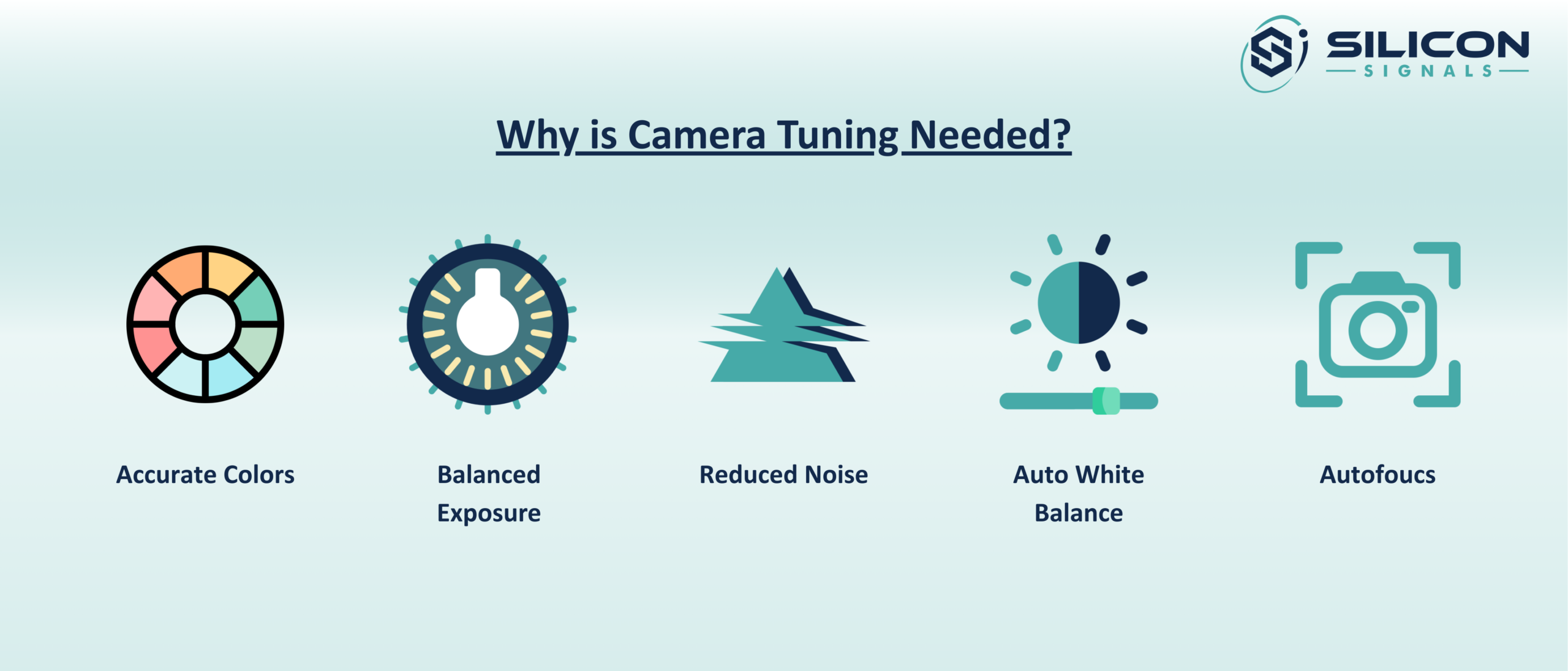
Even if two cameras use the same sensor, differences in optics, mechanical design, or ISP implementation can drastically affect output. Tuning ensures consistency and quality across all these variables. It helps achieve:
- Accurate color reproduction
- Balanced exposure and dynamic range
- Reduced noise and artifacts
- Correct auto white balance (AWB), auto exposure (AE), and autofocus (AF)
- Natural tone mapping and contrast
These factors are essential in Camera Design Engineering Services, where consistent, high-quality output is expected across multiple product variants.
When is Tuning Needed?
Tuning is typically required:
- When developing a new camera design
- When the sensor, lens, or optics change
- When the ISP (SoC or firmware) changes
- When lighting conditions or application scenarios differ
- When performance in specific environments (low-light, HDR, daylight) must be improved
In short – any time hardware or software changes impact how the image is captured or processed; retuning becomes essential. This makes tuning one of the core activities in Camera Design Engineering Solutions.
Need custom Camera Design Engineering Solutions for your next product?
Can Tuning be Done on Reference Design or Customer Design?
Camera tuning can be done on both reference and custom designs — but the context differs:
- Reference Design: Ideal for initial bring-up or proof-of-concept. Helps validate sensor and ISP pipeline quickly using vendor tools.
- Customer Design: Required for final tuning, since lens, optical stack, and thermal conditions affect performance. Reference tuning rarely translates 1:1 to a custom board due to these differences.
Hence, tuning should be redone on the customer’s final hardware to achieve production-grade results, which is standard practice in Camera Design Engineering Services and product development cycles.
Subjective vs Objective Tuning
Camera tuning has two broad approaches:
| Type | Description | Examples |
|---|---|---|
| Objective Tuning | Uses quantitative methods to achieve target metrics like color accuracy (ΔE), SNR, or sharpness. | Factory calibration charts, light boxes, ISO measurements |
| Subjective Tuning | Focuses on how the image “looks” to the human eye — naturalness, warmth, contrast. Used heavily in consumer cameras. | Image review under varied scenes, daylight / human skin tone tuning |
A good camera product often needs both — objective tuning ensures accuracy, subjective tuning ensures appeal. In Camera Design Engineering, both approaches are used together for optimal results.
Types of Tuning
| Tuning Type | Description |
|---|---|
| Color tuning | Adjusting color matrices for realistic colors |
| 3A tuning (AE, AWB, AF) | Auto exposure, white balance, and focus tuning for adaptive response |
| Noise and sharpness tuning | Balancing denoise filters with sharpening algorithms |
| Lens shading correction (LSC) | Correcting brightness fall-off from lens edges |
| HDR tuning | Optimizing tone mapping for high dynamic range scenes |
| Thermal tuning | Adjusting parameters based on sensor temperature changes |
These form the core tuning tasks handled in Camera Design Engineering.
Hardware and Software Factors Affecting Tuning
Any change in the imaging pipeline — hardware or software — can alter image response, necessitating retuning.
Hardware Factors
| Hardware Factor | Impact |
|---|---|
| Sensor change | Alters color response and noise profile |
| Lens change | Affects focus, distortion, and shading |
| IR filter or glass change | Changes color temperature and spectral response |
| Board design change | Modifies sensor clocking or power noise |
Software Factors
| Software Factor | Impact |
|---|---|
| ISP firmware update | Changes algorithm behavior (AE, AWB) |
| Kernel driver changes | Alters gain/exposure register settings |
| Tuning tool version | May interpret calibration files differently |
| Integration with AI-based ISP | Affects pipeline parameters dynamically |
These variations are central considerations in Camera Design Engineering Services, ensuring optimized output despite hardware/software shifts.
Tuning Process Overview
A typical tuning process includes:
- Setup and calibration environment – Use a controlled lighting box, gray cards, color charts (e.g., X-Rite Macbeth).
- Sensor bring-up and RAW capture – Capture RAW frames at various exposures and lighting.
- Initial tuning – Use vendor tools or ISP SDK to load base tuning.
- Color and 3A tuning – Optimize color correction matrix, gamma, AWB, AE, AF.
- Fine tuning – Adjust noise, sharpness, contrast.
- Validation – Test under multiple real-world scenarios (indoor, outdoor, night).
- Documentation and versioning – Save tuning profiles with metadata for reuse and traceability.
This structured approach aligns with best practices followed in professional Camera Design Engineering teams.
Who Is Involved in Camera Tuning?
| Stakeholder | Role in Tuning |
|---|---|
| Sensor Vendor (e.g., Sony) | Provides sensor datasheet, spectral response, and basic tuning reference |
| SoC Vendor (e.g., Qualcomm, NXP, TI) | Supplies ISP tuning tools, SDKs, and documentation |
| Lens Vendor | Provides lens profile, distortion maps, shading info |
| Design House (like Silicon Signals) | Integrates hardware + ISP + optics and performs actual tuning for target product |
| Customer / OEM | Defines final image quality goals and performs validation |
This collaboration reflects how Camera Design Engineering Services are delivered in real-world projects.
Examples of Tools and Ecosystem
Tuning depends on the platform ecosystem. A few examples:
- Qualcomm – Uses proprietary tools like QXDM and OEM camera tuning suite.
- NXP (i.MX) – Uses ISP tuning tools from Basler or e-con Systems with support for V4L2 and GStreamer.
- Texas Instruments – Provides tuning within Imaging Development Kit (IMXDK) and DCC tools.
- Sony IMX sensors – Have reference tuning guides and characterization data.
- Open-source – Frameworks like libcamera offer YAML-based tuning files for pipelines (e.g., Raspberry Pi, Rockchip).
Open tuning approaches like libcamera make it easier for developers to explore ISP behavior transparently — a growing trend in modern Camera Design Engineering Solutions.
Looking for Camera Design Engineering Services?
What Requires Tuning?
Key elements requiring tuning include:
- Auto Exposure (AE) and White Balance (AWB)
- Color Correction Matrix (CCM)
- Gamma and Tone Mapping
- Denoising and Sharpening
- Lens Shading Correction
- Temporal and spatial filtering parameters
- Edge enhancement and contrast
- 3A performance under different lighting (fluorescent, tungsten, daylight)
Each of these is a core part of Camera Design Engineering Services for embedded and AI-driven camera products.
Conclusion
Camera tuning is both an art and a science — requiring a deep understanding of optics, image sensors, and ISP algorithms. It directly impacts user perception and application performance. As camera technology evolves, with AI-assisted ISPs and computational photography, the role of tuning experts and design houses like Silicon Signals becomes increasingly vital to bring out the full potential of imaging hardware.
For companies seeking high-performance imaging, leveraging Camera Design Engineering, Camera Design Engineering Services, and Camera Design Engineering Solutions ensures that products meet the highest industry standards while staying competitive in demanding markets.
