

You learn a hard truth quickly if you work with cameras for a long time. You can’t buy good image quality. You design it. You can choose a good sensor. You can choose a good lens. You can even pick a good SoC. And still get pictures that don’t look right. Colors move around. Shadows fall down. A clip of the highlights. There is noise where it shouldn’t be. There is almost always a difference between what the hardware can do and what the camera actually delivers. This is because of how well the ISP is tuned.
This is where camera design engineering services come in handy. Tuning the ISP is not the last step. It affects the whole process; from the first time it is brought up to the last time it is validated. When done right, it cuts down on rework, speeds up development cycles, and makes performance more predictable instead of hopeful.
Let’s break it down the right way, starting with the facts about the industry.
The Market Reality: Why ISP Tuning Matters More Than Ever
There are cameras everywhere now. They are important for the safety of Automotive systems, Industrial, surveillance and more. They are used to check on industrial machines. Retail analytics, farming, medical devices, drones, surveillance, and robotics all need images that are always clear.
A MarketsandMarkets report says that the global image sensor market will be worth more than USD 30 billion by the end of the 2020s. This will be mostly because of AI-based and embedded vision systems. But this is the part that most specsheets don’t talk about. According to several industry surveys, including data from Tier-1 automotive suppliers, almost 40% of camera-related project delays happen after the hardware has been chosen. The main problem is not sensor availability but tuning and validating image quality.
This really means something simple.
Choosing the right hardware is the first step. ISP tuning helps you cross the finish line. This is why modern camera design engineering solutions see ISP tuning as a core part of their work, not something that can be skipped.
What an ISP Really Does in a Camera System
An Image Signal Processor is the part of the system that turns raw sensor data into something usable. Sensors are honest devices. They just measure photons. They do not understand color, contrast, or intent.
Most image sensors output raw data, usually in a Bayer pattern. Each pixel knows only one-color component. Red, green, or blue. Everything else has to be inferred, corrected, and shaped.
That shaping happens inside the ISP.
The ISP handles tasks like demosaicing, color correction, noise reduction, exposure control, white balance, tone mapping, sharpening, and output formatting. Some of this happens in hardware blocks. Some is controlled through firmware parameters. All of it affects what the camera sees and how downstream algorithms behave.
The act of configuring these parameters to match the application is called ISP tuning. And it is where theory meets reality.
Planning a camera-based or embedded vision product?
ISP Tuning: More Than Image Beauty
Here’s the thing. ISP tuning is not about making images look nice. It is about making images useful.
Take a simple example. An automated liquid handling system in a laboratory identifies test samples by reading the color of caps on test tubes. If white balance shifts slightly under fluorescent lighting, the AI model starts misclassifying samples. Nothing changed in the hardware. The failure came from insufficient ISP tuning for that lighting condition.
Or consider a harvesting robot in agriculture. The decision to pick fruit depends on subtle color differences. If the ISP exaggerates saturation or compresses highlights, the robot harvests too early or too late.
In both cases, the camera works. The system fails. This is why camera design engineering services focus on tuning as a system-level activity, not a cosmetic adjustment.
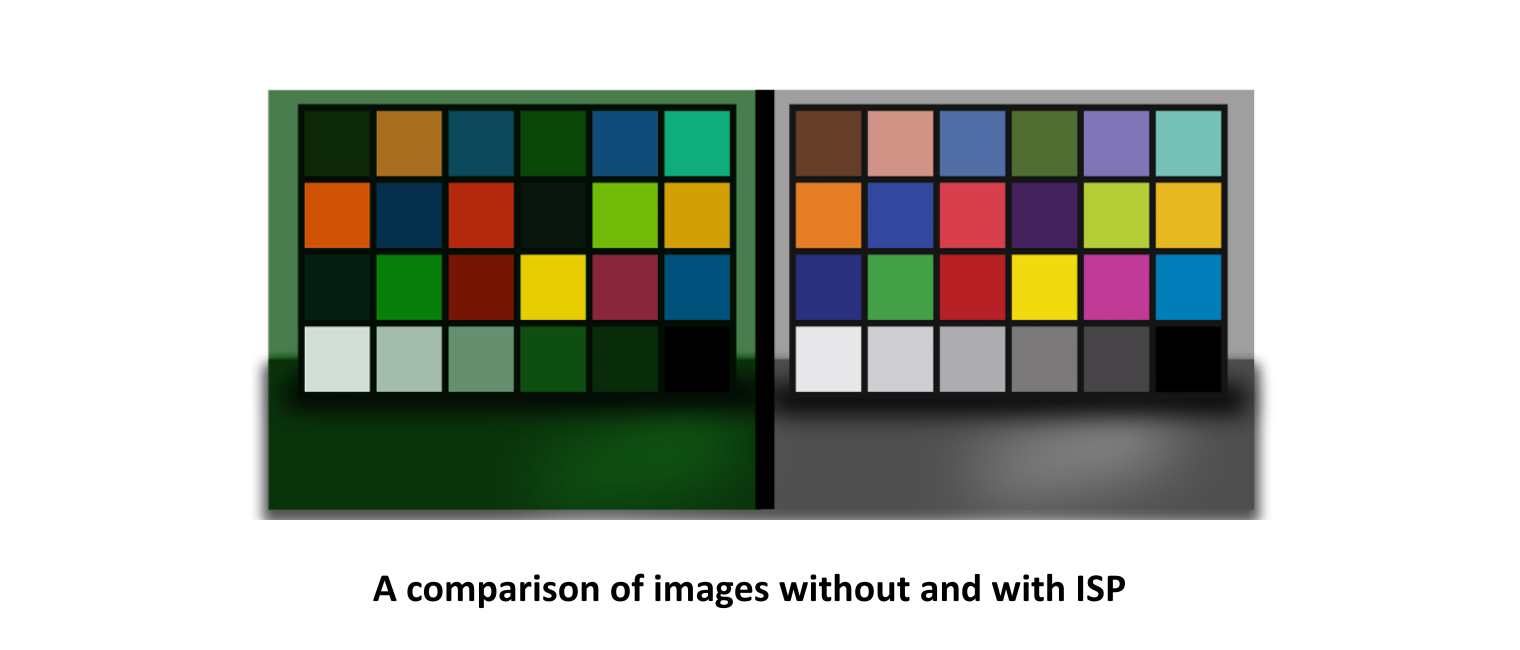
How ISP Tuning Shapes the Camera Engineering Workflow
Let’s walk through the workflow and see where ISP tuning changes the game.
Early Bring-Up and Sensor Validation
When teams are first getting things up and running, they often have trouble telling the difference between sensor problems and ISP problems. The raw images look noisy. The colors are wrong. Exposure acts in ways that are hard to predict.
Without a structured tuning approach, teams spend weeks fixing the wrong layer.
A tuned baseline ISP profile lets you know right away if the sensor, optics, and analog front end are working properly. Not just a processing block; it becomes a diagnostic tool. Camera design engineering solutions that include early-stage tuning cut down on false hardware respins and speed up bring-up a lot.
Stable Exposure and Gain Control
One of the most overlooked parts of ISP tuning is auto exposure. Badly tuned AE can cause flickering, motion blur, or shadows that are too dark.
Imagine a smart traffic camera that works all day and night. The lighting changes all the time. Streetlights, headlights, shadows, and rain. The camera shakes if the AE parameters aren’t set up right for these changes. Frames don’t line up anymore. The accuracy of detection goes down.
When you tune AE, you don’t just choose one value. It has to do with defining behavior in different situations. This is where camera design engineering services with a lot of experience really help.
Color Accuracy and Auto White Balance
Auto White Balance seems easy until you try it in the real world. Lamps that use sodium vapor. Lighting that is mixed. Infrared leak. Thoughts.
An ISP does white balancing by picking a reference white and changing the gains to match. But the things that work in a lab don’t always work in the real world.
When you tune things right, color correction matrices and AWB algorithms will work with the application. Skin tones are important in retail analytics. In farming, greens and reds are important. Consistency is more important than looks in medical imaging.
This level of alignment is only possible with strict tuning workflows.
Noise Reduction Without Destroying Detail
There is a trade-off with noise reduction. If you don’t have enough, low-light pictures fall apart. If you do too much, the small details will disappear.
In other words, noise reduction needs to be set up in context. The right balance depends on the frame rate, sensor gain, pixel size, lighting conditions, and even AI processing that happens later.
Camera design engineering solutions see noise tuning as a system choice, not just a single slider. The result is clearer pictures that still keep important features for analysis.
A Practical Example: External ISP in Industrial Vision
A lot of industrial cameras have sensors like the onsemi AR0234 and an external ISP like the AP1302. The sensor takes in unprocessed frames. Demosaicing, color correction, noise reduction, and exposure are all handled by the ISP.
This combination looks simple on paper. In real life, the default ISP profile almost never works right away.
Glare from metal surfaces was a problem for one industrial inspection system. The ISP’s tone mapping was too strong, which made it hard to see defects. The tone curve was changed to keep highlight detail while keeping mid-tone contrast by tuning the ISP in a specific way. No changes to the hardware. No change of sensors. Just tuning.
This is a great example of how ISP tuning can make workflows better by fixing problems at the right level.
Core Functions of an ISP, Explained Without the Marketing
- An ISP is involved in almost every step of making an image. Let’s look at what it does in context, not as a list.
- The Bayer pattern is used by the image sensor to get raw data. The ISP starts processing, sets up timing, and sets up pipelines. Demosaicing uses data from neighboring pixels to build full-color pixels. If not tuned correctly, this step alone can cause artifacts.
- Color correction makes the output from the sensor match the colors in the real world. Different combinations of sensors and lenses work in different ways. Generic matrices don’t often work with different programs.
- Noise reduction stops random changes, especially when the gain is high. To keep motion and textures from smearing, you need to carefully tune temporal and spatial filters.
- Auto Exposure changes the gain and integration time. Flickering and instability happen when the AE loop isn’t set up right.
- Auto White Balance makes up for changes in light. The ISP has to figure out what white means in each scene.
- The stages of image enhancement change the sharpness, contrast, and gamma. These steps tell us how useful the image is for people and computers.
- Lastly, the ISP sends the image out in a format that can be displayed, stored, or processed by AI.
- Each of these steps has an effect on the next one. ISP tuning is about making them work together as a system.
Designing an embedded vision product and unsure which ISP fits best?
Types of ISPs and Their Impact on Workflow
There are three main types of ISPs: on-sensor, on-SoC, and external. The choice has an effect on both the design and the tuning work.
On-Sensor ISP
An ISP that is built into the image sensor itself is called an on-sensor ISP. This makes it easier to design hardware and lowers latency and power use. This might be enough for simple apps with lighting that doesn’t change.
But you can’t change the tuning very much. You work within the limits set by the vendor. Camera design engineering services often suggest on-sensor ISPs when customization needs aren’t as important as cost, power, and ease of use.
On-SoC ISP
The main processor has an on-SoC ISP. This happens a lot on platforms like Qualcomm-based systems and NXP i.MX. The ISP uses the same resources as the CPU, GPU, and DSP.
This setup is more flexible than on-sensor ISPs and works well with AI pipelines. Tuning can be harder, but it can also be more powerful. This architecture is the basis for many modern camera design engineering solutions.
External ISP
An external ISP is a separate chip that only works on images. It has the best performance and flexibility. You can do complex tuning, make your own pipelines, and use advanced control loops.
The trade-off is that the BOM cost and integration work will be higher. External ISPs are often worth it for apps that need very high image quality.
It’s not just about the features when you choose an ISP. It’s about how much power you need over the workflow.
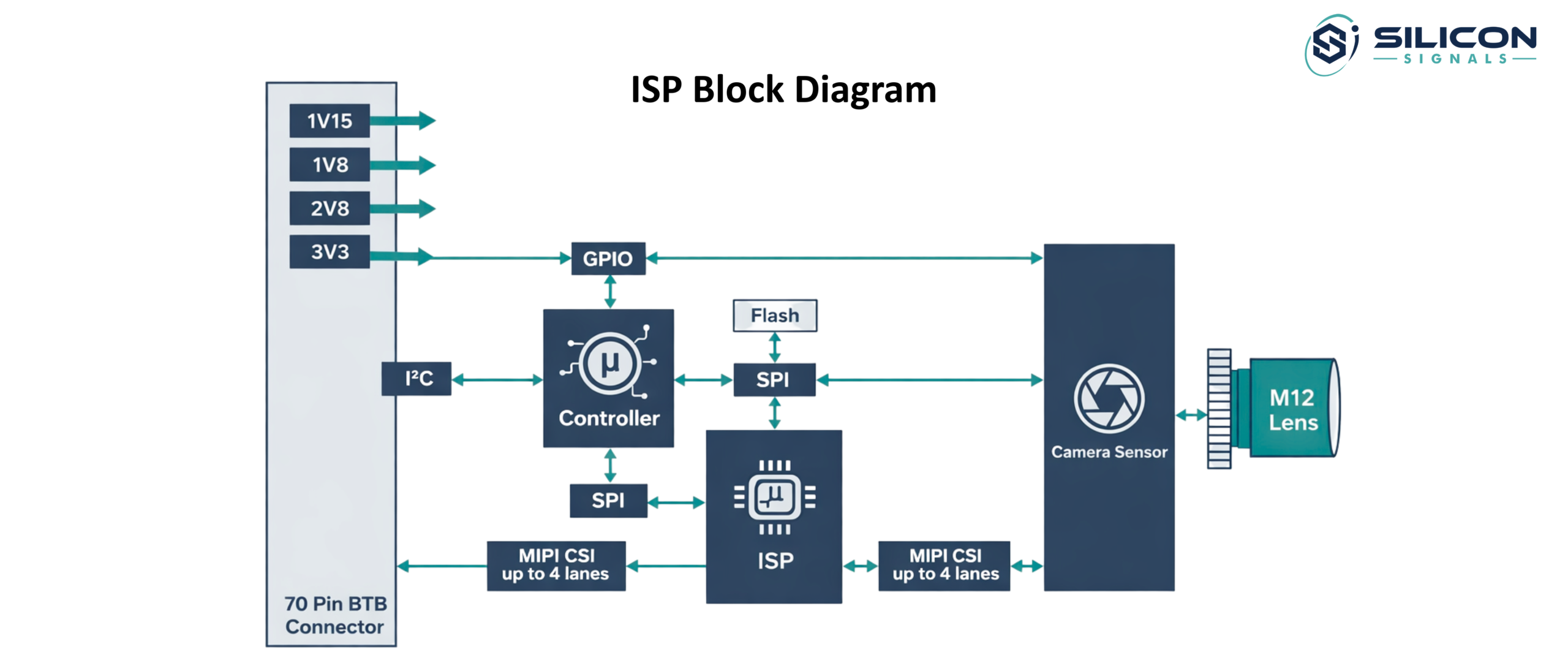
Where Camera Design Engineering Solutions Fits into This Picture
A good camera design engineering solution partner doesn’t see ISP tuning as a separate job. It is built into the larger process of designing cameras.
The team works with on-sensor, on-SoC, and external ISP architectures for industrial vision, surveillance, and embedded AI systems. The focus is always the same. First, get to know the application. Then set up the ISP to work with that app, not the other way around.
In one embedded vision project, tuning was all about getting the AI-based inspection system to show colors correctly in different types of light. In another case, the main goals were clear motion and low latency for real-time monitoring. The hardware platforms were not the same. The discipline of workflow stayed the same.
This method makes camera design engineering services more like predictable steps instead of guesswork.
Choosing the Right ISP for Your System
There is no one answer that fits all. The best ISP for you will depend on how much processing power you need, how much you can spend, how much power you have, and how good the image quality needs to be.
An on-sensor ISP may be all you need if your application only needs basic imaging and has strict budget limits. An on-SoC ISP is often a good choice if you need both balance and integration. If you need high-quality images and can’t change anything, an external ISP is usually the best choice.
Camera design engineering solutions help you make this choice early, before you have to make decisions about the building itself.
Conclusion: Why ISP Tuning Defines Camera Engineering Success
Here’s the bottom line. Cameras fail quietly. They boot. They stream. They look fine until they are asked to perform under real conditions.
ISP tuning is what closes the gap between lab demos and real-world performance. It shapes how sensors, optics, and algorithms work together. It turns raw data into reliable input for decisions.
This is why ISP tuning enhances camera design engineering workflows so deeply. It reduces rework. It improves predictability. It aligns image quality with application intent.
At Silicon Signals, ISP tuning is treated as a first-class engineering discipline within camera design engineering services. Not a last-minute polish. Not a vendor checkbox. A deliberate, structured process that supports real products in real environments.
If your camera matters to your product, your ISP tuning should matter to your workflow.
