How Embedded Hardware Engineering Enables Wearables?

icon

Table of Contents

The Rise of Smart Medical Wearables

In 2024, the global market for wearables was worth $84 billion. Healthcare wearables are one of the fastest-growing parts of that market. According to Grand View Research, wearables that focus on health and medicine will grow at a rate of more than 26% per year until 2030. This is because the population is getting older, there are more chronic diseases to manage, and there are new ways to provide care from a distance. According to Deloitte’s healthcare outlook, over 70% of hospitals around the world now use some kind of remote patient monitoring. This is another piece of information that you should pay attention to.

Those numbers are important to look at because they show a change. Hospitals aren’t the only places that provide healthcare anymore. It’s spreading to the skin on the wrists, chests, arms, and patches. Embedded hardware engineering is the only thing that can make that change happen, and it does so quietly behind the scenes.

Smart medical wearables don’t work because they look good or have high-resolution screens. They work when the hardware, firmware, power systems, and connectivity work as expected in the real world for months or even years. Hardware Development Services and Hardware Product Design are what make the difference.

This article will explain how embedded hardware engineering makes medical wearables work reliably. We’ll talk about the architecture, the trade-offs that engineers have to make, the choices about power and connectivity, and the real problems that teams run into when they build these devices.

This is the thing. Wearables are not just tiny phones. They are systems that were made for a specific purpose and have strict limits. If you don’t design them with that in mind from the start, the product fails quietly and costs a lot of money.

Why Embedded Hardware Engineering Is the Backbone of Medical Wearables

Medical wearables should be able to do three things at once: gather accurate data, run all the time, and not get in the way of the user. That mix is not forgiving.

Embedded hardware engineering is the field that combines sensor physics, low-power electronics, and real-time computing. Even the best algorithms or mobile apps won’t work without good hardware.

Real-Time Health Monitoring Starts at the Hardware Layer

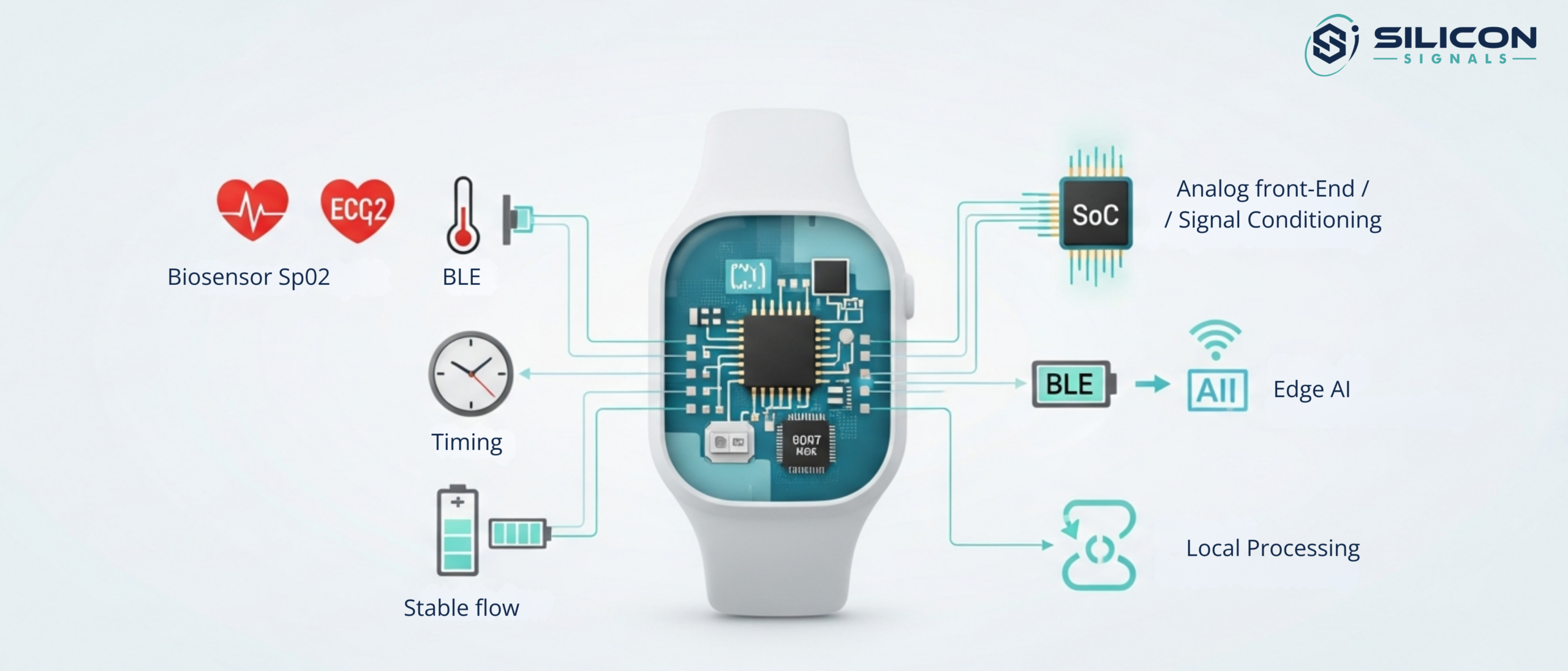
Sampling data is only one part of continuous health monitoring. It has to do with timing, controlling noise, keeping the signal strong, and where the sensors are placed. The quality of the raw data, like heart rate, SpO₂, ECG, body temperature, or motion, depends on how well the hardware is made.

A poorly chosen analog front end can add noise that no software filter can completely get rid of. Trends can be messed up by sensors that don’t always work at the same time. When wireless transmission is going on, power rail instability can mess up readings.

This is why Hardware Product Design for medical wearables puts a lot of emphasis on sensor interfacing, PCB layout discipline, and clock accuracy. The hardware sets the highest level of performance. Software can only make things better up to that point.

Real-Time Health Monitoring Starts at the Hardware Layer
Power Efficiency Is an Engineering Problem, Not a Feature

Users expect wearables to last days or weeks on a single charge. In medical applications, frequent charging is not just inconvenient; it’s risky. A dead device means lost data and missed alerts.

Achieving long battery life is not about one magic component. It’s the sum of hundreds of small decisions made during hardware development.

Microcontroller selection, sensor duty cycling, voltage regulator efficiency, sleep-state transitions, and radio wake-up timing all stack together. Hardware Development Services teams spend a disproportionate amount of time modeling power budgets long before the first prototype is built.

What this really means is that battery life is built in, not improved later.

Edge Intelligence Depends on Hardware Capability

AI in medical wearables is getting closer to the edge. Instead of sending raw data to the cloud, devices are now processing data locally to find trends, anomalies, and events in real time.

That change needs hardware that can handle light inference without using up the battery or getting too hot. Engineers need to find a balance between the power limits, thermal limits, and computing power.

By pairing the right MCU or SoC with the right memory, acceleration support, and power management, embedded hardware engineering makes this balance possible. Edge AI turns into a marketing slide instead of a useful feature without this base.

How Embedded Systems Are Architected Inside Medical Wearables

It is best to think of a medical wearable as a pipeline rather than a set of components. Every block depends on the proper behavior of the one before it.

Sensing is the first step. Physical signals are transformed into electrical ones by optical, electrical, or mechanical sensors. Analog front ends condition these signals before the processor samples them. Real-time firmware on the processor controls communication, acquisition, filtering, and inference. Lastly, data is safely sent to a cloud system, gateway, or phone.

It is the responsibility of the embedded hardware engineer to ensure that each of these phases functions even in the most dire circumstances. The environment includes things like sweat, motion, temperature fluctuations, electromagnetic interference, and aging components.

Because of this, medical wearables’ hardware product design differs greatly from that of consumer electronics. Validation cycles are longer and error margins are smaller.

Designing medical wearable and facing power, size, or reliability challenges?
Create your product error-free with Silicon Signals

Core Technologies Inside Embedded Medical Wearables

Sensors and Biosensors as the Primary Data Source

Biosensors that work directly with the human body are what medical wearables use. Photoplethysmography is a method that optical sensors use to measure blood oxygen and pulse. The heart sends electrical signals to ECG electrodes. Temperature sensors keep track of changes in skin or core body temperature. Motion sensors can tell if someone is moving, standing, or falling.

From a hardware point of view, each sensor has its own set of problems. Optical sensors are sensitive to light that leaks into the room and motion artifacts. It is important to carefully isolate and reduce noise around ECG sensors. To avoid getting false readings, accelerometers need to be set up and calibrated correctly.

Embedded hardware engineering makes sure that these sensors are not only there but also work in everyday situations.

Low-Power Processing at the Core

Most medical wearables have a low-power embedded processor at their core. This area is mostly made up of ARM Cortex-M families, new RISC-V MCUs, and application-specific SoCs.

These processors oversee scheduling tasks in real time, controlling sensors, processing data, encrypting it, and sending it. Their choice affects everything from how complicated the firmware is to how well it follows the rules.

Good Hardware Development Services teams look at processors not just how well they work, but also how mature the ecosystem is, how long they will be available, and how they behave with power in different operating modes.

Wireless Connectivity and Its Trade-Offs

Connectivity defines how data leaves the device, but it also defines a large portion of the power budget. Choosing the wrong wireless technology can break an otherwise solid design.

Different medical wearables use different communication standards depending on range, data rate, and deployment model. The table below compares common options.

Technology Typical Range Power Profile Typical Medical Use Case Primary Advantage
Bluetooth Low Energy (BLE) Up to 100 meters Very low Smartwatches, fitness bands, ECG patches Minimal power consumption
Wi-Fi Up to 100 meters Medium to high Home-based patient monitoring High data throughput
NB-IoT City-wide Low Clinical-grade remote monitoring Reliable cellular coverage
LoRaWAN Up to 15 km Very low Elderly care, emergency alerts Long range, ultra-low power

This is the thing. Decisions about connectivity should be made early because they affect the design of the antenna, the materials used for the enclosure, the size of the battery, and the architecture of the firmware. It’s expensive to change them later.

Real-World Use Cases of Embedded Systems in Medical Wearables

AI-Powered Smartwatches and Health Trackers

There is much more to modern smartwatches than just counting steps. They identify irregular vital signs, examine sleep patterns, and identify arrhythmias. This is all made possible by embedded systems’ intelligent coordination of power, processing, and sensors.

For instance, in order to comply with medical accuracy standards, ECG-enabled watches need to have precise timing and noise control. Hardware design decisions made long before the product is used by consumers to provide that capability.

Biosensors for Chronic Disease Management

Continuous data, as opposed to intermittent measurements, is essential for managing chronic diseases. Wearable biosensors for cardiac health, blood pressure, or glucose must function consistently without constant user intervention.

One excellent example is a continuous glucose monitor. In a small form of factor, they integrate wireless transmission, embedded processing, and chemical sensing. For weeks at a time, the embedded hardware must maintain stability in the face of temperature fluctuations and physical movement.

Elderly Care and Fall Detection Systems

Fall detection wearables highlight the importance of motion sensing and connectivity. These devices must distinguish between normal movement and dangerous events without generating false alarms.

Embedded hardware engineering plays a key role here by selecting the right motion sensors, configuring interrupt-driven processing, and ensuring that alerts are transmitted even when power is low or network conditions are poor.

Engineering Challenges That Define Medical Wearables

Engineering Challenges That Define Medical Wearables
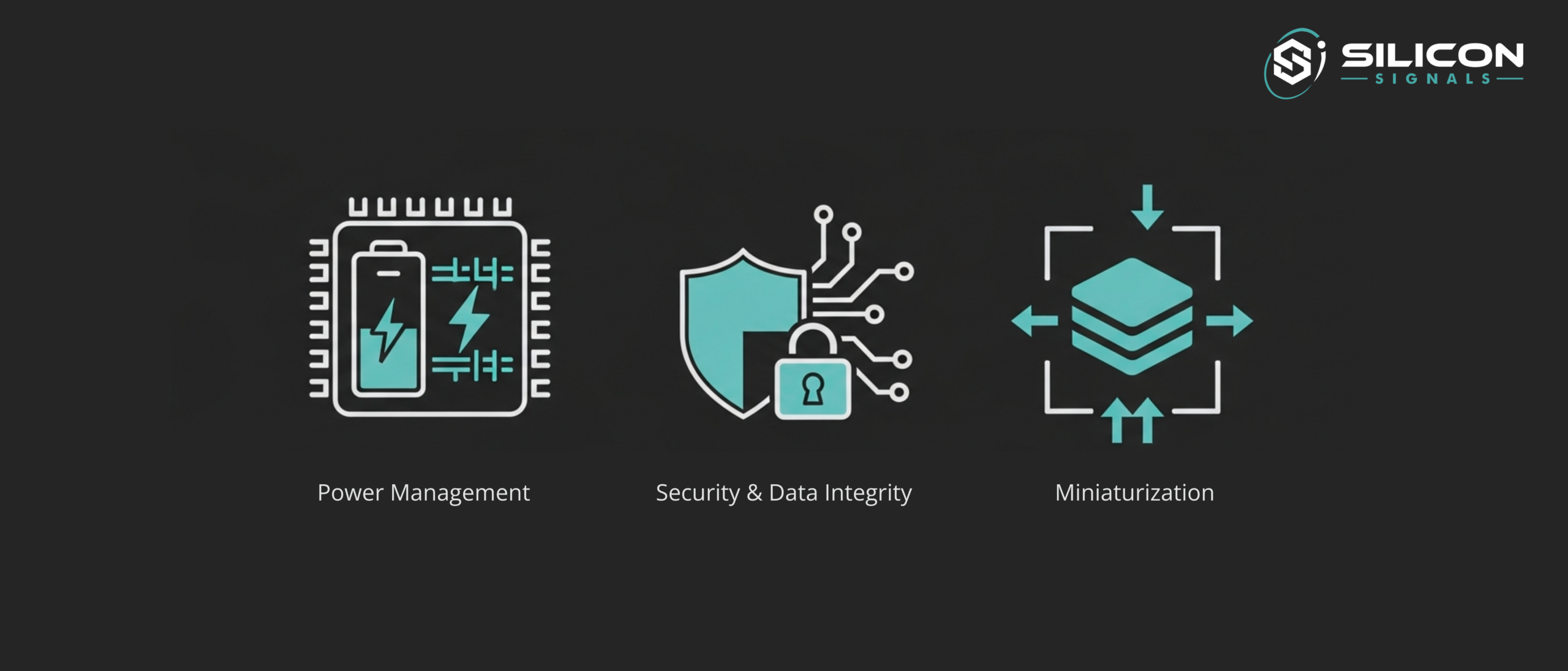
Power Management Under Real Constraints

The hardest thing is always battery life. Engineers need to think about how often sensors sample data, how often radios are used, how long processors sleep, and how batteries age.

In medical wearables, aggressive power optimization can’t make them less reliable. That balance is reached through careful hardware design instead of last-minute firmware hacks.

Security and Data Integrity

Medical information is private. Secure boot, encrypted storage, and protected communication channels must all be supported by embedded hardware. These features are built in, not extras. They affect the choice of processors, the memory architecture, and the ways to update them.

Following rules like HIPAA or GDPR often starts with the hardware layer.

Miniaturization Without Compromise

Smaller devices are easier to use, but making things smaller can also make them more dangerous. It is harder to fix problems with dense PCBs, and they are more likely to have thermal and EMI problems.

Teams that hardware product design with a lot of experience see size reduction as a controlled process, weighing comfort against reliability and ease of manufacture.

Ready to turn your wearable concept into a field-ready medical product?
Connect with Silicon Signals to create it market ready

Where Embedded Hardware Engineering Is Heading Next

The next generation of medical wearables will push more intelligence onto the device. Edge AI will reduce latency and preserve privacy. Energy harvesting techniques will extend operational life. Advanced connectivity, including 5G, will enable richer remote diagnostics.

What this really means is that hardware engineering will only become more critical. As expectations rise, there will be less tolerance for shortcuts or overpromised features.

Conclusion: Turning Wearable Ideas into Reliable Medical Products

How well the hardware inside medical wearables is built determines whether they work or not. Under tight limits and in real-world situations, sensors, processors, power systems, and connectivity must all work together. In this area, generic designs and quick decisions don’t last.

Silicon Signals sees embedded hardware engineering as a discipline that works at the system level. From the first decisions about architecture to power modeling, PCB design, and validation, the goal is always to make medical wearables that work the same way in the real world as they do in demos.

The right engineering partner can make the difference between a promising prototype and a reliable product if you’re making smart medical wearable and need Hardware Development Services or Hardware Product Design expertise that knows these facts.

About the Author

Picture of Pujan Dwivedi
Pujan Dwivedi
Pujan has a proven track record in multi-layer PCB design, encompassing all stages from schematic development and layout creation through to the final prototyping phase. His hardware design expertise extends across various platforms, including NXP i.MX and Rockchip.