

The global embedded systems market is expected to grow from $95.2 billion in 2023 to $163.2 billion by 2030, with a compound annual growth rate (CAGR) of 7.9% Markets&Market. The market for designing and developing products is expected to reach $2.5 trillion by 2034 Precedence Research. Not only are these numbers big, but they also tell a story. Design engineering is what makes everything you touch work, from the smartphone in your pocket to the car you drive. And not just any design, but engineering that combines hardware, software, and mechanical systems into something that works well, is reliable, and is ready for use.
In other words, design engineering isn't just about making a drawing or writing some code. It's about making things that work in the real world, from coming up with ideas and building prototypes to making them on a large scale.
So, let's go over it step by step. What does a design engineer do during the process of making a new product, and why is their job so important?
What Is Product Design Engineering?
The main goal of product design engineering is to create and build products that reliably solve a problem or do a job. It's the field that makes sure an idea written down on a napkin becomes something you can hold in your hands.
This is about more than just looks. Engineers who work in this area have to deal with:
- Functionality: Does the product work as it should?
- Efficiency: Does it use power and resources wisely?
- Durability: Is it strong enough to handle the conditions it's made for?
- Cost: Is it possible to make it cheaply without making any compromises?
Product design engineering goes deeper into the technical details than industrial design, which focuses more on form and user experience. It involves choosing microcontrollers, integrating sensors, writing firmware, and making sure everything works in the real world.
Mechanical Product Engineering: Building the Physical Backbone
There is a skeleton in every device. That's where mechanical product engineering comes in.
Mechanical engineers are in charge of the physical structure, which includes the enclosures, mounts, heat dissipation systems, and moving parts. As an example:
- They figure out how to fit sensors, batteries, and a display into a slim case for a smartwatch.
- They design the frame for a drone so that it is light but strong enough to handle crashes and vibrations.
- They make sure that the enclosures for medical devices are biocompatible and easy to clean.
The problem is finding the right balance: making something that lasts without being too heavy, is small without getting too hot, and is cheap without sacrificing quality.
Looking for experts who blend mechanical product engineering with smart electronics?
Reading Any Android Sensor Data with IIO
Creating a prototype: making ideas come true
You can only learn so much from a drawing or even a 3D model on a screen. No one really knows how a product will work in the real world until it is built, touched, and tested. That’s why making a prototype development is one of the most important steps in product design engineering.
In a way, a prototype is the first draft of the product. It might not look polished, but its job is to answer hard questions early: Does this idea really work? Will it last through daily use? Are there problems we haven’t seen yet?
What prototyping lets engineers do is
Quickly test ideas: Engineers can build a working version of an idea and see how it works instead of arguing about it for hours.
Find design flaws early: When you test the prototype, small design mistakes, like a sensor that isn’t lined up right or a power draw that isn’t efficient, become clear.
Test how easy it is to use and how comfortable it is: What does the product feel like in someone’s hand? Is it easy to find the buttons? Does the user understand how to use the interface?
Check the integration of hardware and software: This is where the two come together. Prototypes show if the microcontrollers, sensors, and software logic you chose work well together.
For example, an IoT thermostat. Before going into mass production, engineers make prototypes to find out things like:
Are the temperature sensors giving accurate readings in different situations?
Does the wireless connection (Wi-Fi or Zigbee) stay stable and not drop out often?
Is the user interface easy to understand and responsive enough for homeowners to change settings?
The best thing about developing prototypes is how quickly and cheaply they can be made. Teams can avoid expensive redesigns and recalls by finding problems before they go into production. A well-planned prototype cycle can cut months off the time it takes to make a product and save millions of dollars in wasted manufacturing costs.
This really means that prototyping isn’t just a step on a list; it’s the most important part of making products that work. It connects ideas to action, helping them turn into real solutions that can be confidently moved forward to mass production.
The Product Development Process: Step by Step
The Journey of Product Development: Step by Step
The process of making a product isn’t just a straight line from idea to finished device; it’s a structured journey with many steps, improvements, and engineering discipline. Here’s a closer look at how embedded product development usually goes:
- Setting Requirements
There is a reason for every product. Engineers always ask, “What problem does this fix?” Who will make use of it? At this point, both technical and business needs are collected. These needs can include things like performance benchmarks, safety standards, user experience expectations, and compliance needs. A good requirements document is like a blueprint that keeps you from making expensive mistakes later.
- Designing the Idea
When the requirements are clear, teams move on to the conceptual design phase. Engineers draw out the system architecture here, marking important parts like microcontrollers, sensors, power supplies, communication protocols, and even mechanical enclosures. At this point, choices like whether to use an RTOS or how to handle connectivity (Wi-Fi, BLE, Zigbee, CAN, etc.) will affect the whole project.
- Hardware Product Engineering
This is where the product’s physical structure starts to take shape. Engineers carefully choose parts, create multi-layer PCBs, test signal integrity, and make plans for strong power management for hardware product engineering. Early versions of the board are made, tested, and often redesigned to find the right balance between performance, cost, and ease of making.
- Making Firmware and Software
Software is the star of the show once the hardware is in place. Embedded engineers write low-level code in C or C++, make device drivers, set up RTOS tasks, and make sure that communication protocols like I2C, SPI, UART, or CAN work properly. Middleware, connectivity stacks, and application logic start to make the bare hardware “smart.”
- Debugging and Integration
It’s rare for hardware and software to work perfectly the first time. This step is all about getting them all together and fixing any bugs that come up. Engineers use tools like JTAG debuggers, oscilloscopes, and logic analyzers to find timing problems, track down electrical signals, and fix communication problems. Integration is the point at which theory and reality meet.
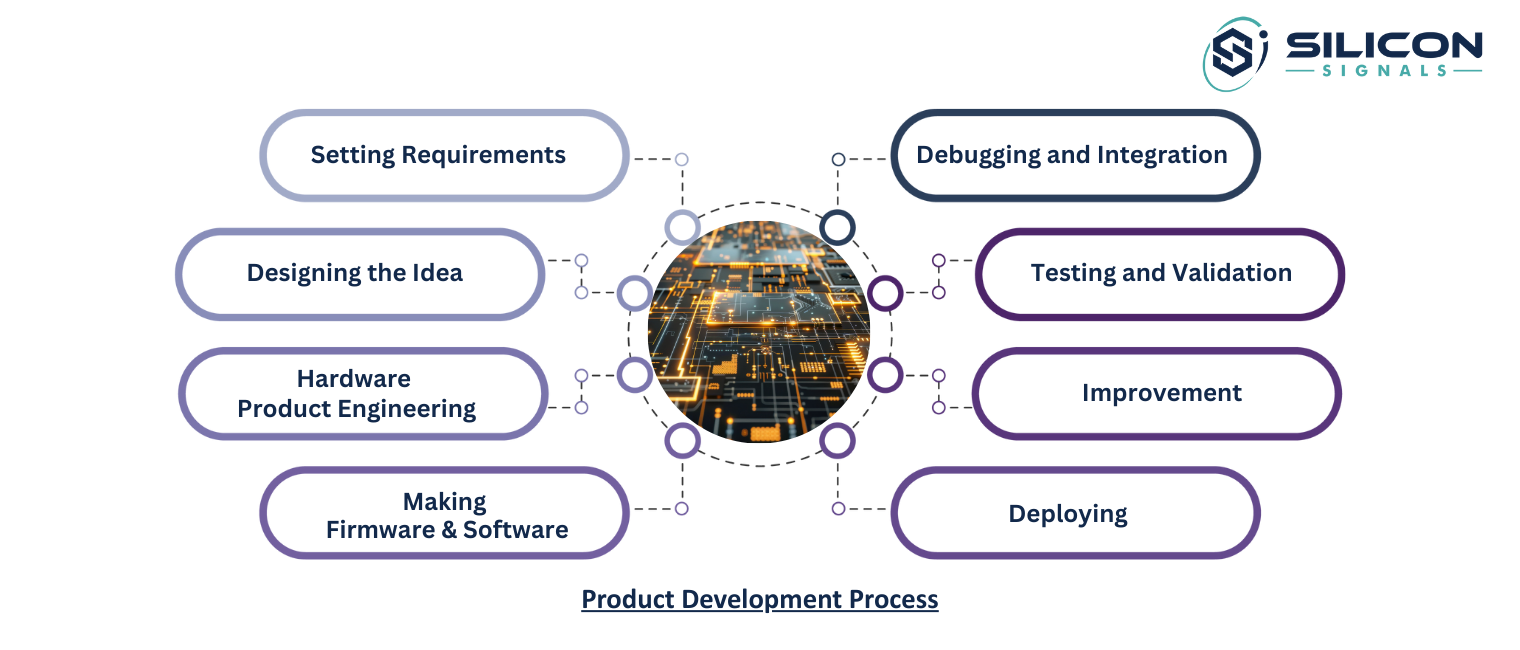
- Testing and Validation
You have to test products that are meant to be used in the real world. Stress testing, environmental testing (for heat, cold, vibration, and humidity), EMI/EMC checks, and power profiling are all parts of validation. In this case, engineers make sure that the system works well not only in the lab but also in the real world, where it will be used.
- Improvement
After it works, the product goes through rounds of optimization. You can change the firmware to make it respond faster, use less power, or take up less memory. You can change the layout of the hardware to make it work better. This step makes sure that the product works, is efficient, reliable, and doesn’t cost too much.
- Making and Deploying
Finally, the design is set in stone, and the product is ready to be made. Engineers work with vendors to make sure that the quality of production, testing on a larger scale, and deployment plans are all good. Finalizing the paperwork, certifications, and compliance checks. At this point, the product is ready to go from the engineering benches to the people who will use it.
Hardware Product Engineering: The Brains and the Brawn
Even the smartest software can’t live without good hardware.
Hardware product engineering includes choosing a microcontroller or microprocessor, like ARM Cortex or RISC-V.
- Designing and laying out PCBs
- Power systems (batteries, regulators, converters)
- Combining sensors and peripherals
- Making sure signals are clear and that EMI/EMC rules are followed
For example, if you’re making an automotive ECU, the hardware has to be able to handle extreme temperatures, vibrations, and changes in voltage. That’s not just engineering; it’s resilience engineering.
The Role of Embedded Engineers in Product Development
So what role do embedded engineers play in all of this? They are the ones who work with both hardware and software.
They are in charge of:
- Writing firmware in C/C++
- Using tools like JTAG to find and fix bugs in low-level code
- Improving the system’s speed and power performance
- Making sure that sensors and peripherals work together reliably
- Working with RTOS or embedded Linux platforms
Think of them as translators: they make sure that silicon chips and electronic circuits do what people tell them to do.
Skills That Matter
To thrive in this field, embedded engineers need both hard skills and soft skills.
Technical Skills:
- Programming (C/C++, Python, assembly)
- RTOS (FreeRTOS, Zephyr, ThreadX)
- Communication protocols (I2C, SPI, UART, CAN, Ethernet)
- Debugging with oscilloscopes, logic analyzers
- Embedded Linux (Yocto, Buildroot, kernel drivers)
- IoT connectivity (Bluetooth, Wi-Fi, Zigbee, LoRa)
Soft Skills:
- Problem-solving under tight constraints
- Team collaboration with mechanical and product teams
- Clear documentation and communication
- Time management and adaptability
- Attention to detail and user focus
Why Optimization Is Non-Negotiable
This is the thing: embedded systems often work in places where there aren’t a lot of resources, like limited memory, battery life, and processing power.
That’s why everything is about optimization.
- In wearables, you can get more battery life without losing features.
- In industrial systems: make sure they can handle heavy loads in real time.
- In consumer electronics, keep prices low while providing speed and stability.
Optimization isn’t a choice. It’s a matter of life and death.
Collaboration: The Secret Ingredient
You can’t design a product on your own. Working together across departments is key to success:
- Mechanical engineers make the cases.
- Engineers who work with hardware make boards.
- Embedded engineers write code.
- Product managers make sure that requirements match what the market needs.
You get things like the iPhone, Tesla autopilot systems, or life-saving pacemakers when these groups talk to each other well. What if they don’t? You get delays, recalls, and unhappy customers.
Maintaining and Updating Systems
A product launch isn’t the end of the line. It’s only the beginning of a new phase.
Embedded engineers are in charge of:- Fixing bugs with firmware updates
- Adding features after launch
- Making sure systems are reliable over time
- Keeping systems safe from cyber threats
For instance, automotive infotainment systems get over-the-air (OTA) updates all the time to fix security holes and make them easier to use. That ongoing engineering makes sure that products stay useful and reliable.
Looking to turn your idea into a reliable, market-ready product?
Safety and Security in Critical Systems
When embedded systems control cars, medical devices, or aerospace equipment, the risks are greater.
Engineers need to plan for:
- Safety: keeping big problems from happening
- Redundancy: having backup systems ready to go
- Security: stopping hacks or unauthorized access
If a pacemaker fails or a car’s ECU gets hacked, it’s not just a bug; it’s life or death.

Conclusion
Every new idea starts as a thought, like a sketch on paper, a system block diagram, or a concept pitched in a meeting. But turning that idea into a real product that can be sold on the market takes discipline, iteration, and knowledge of all areas of embedded product engineering.
It’s not just about designing hardware, laying out PCBs, or writing firmware when you build products. It’s about bringing together all three pillars—hardware engineering, electronic product design, and software/firmware development—so that they work together as one. Each step, from bringing up the board and making prototypes to integrating, validating, and optimizing the system, makes sure that the final product is reliable, efficient, and scalable.
Your next IoT product design, smart device, or industrial automation solution won’t work just because you have great ideas. It will work because engineers used both creativity and strict engineering practices. The main goal of product engineering services is to turn problems into solutions and ideas into products that are ready to be sold.
At Silicon Signals, we help speed up this process. We work with businesses to turn ideas into groundbreaking new products. We have proven experience in board bring up, firmware development, custom GUI design, IoT system integration, and product validation. Our team makes sure that you don’t just build a product, but that you also engineer a success story, whether you’re making a connected device, an automotive ECU, or an industrial controller.
At the end of the day, great products aren’t just made; they’re made with vision, skill, and passion.
