

Today, all of the devices around us, like security cameras, industrial vision systems, self-driving drones, ADAS-enabled cars, smartphones, and even smart doorbells, use imaging as their main sense. And here’s the interesting part: more than 90% of the digital data that AI and computer vision systems use comes from a camera sensor. The embedded camera market is growing at a rate of almost 12% per year, according to a Yole Intelligence report from 2024. This is because surveillance, automotive, and IoT devices can’t afford to have bad image quality.
The IEEE CVTS group did another study that found that up to 70% of the drop in performance of AI models in vision applications is due to poor camera tuning, not model accuracy. People are always shocked by that number. Most teams think that having a good sensor will automatically make the imaging work well. No, it doesn’t. The sensor is one part of it. The magic really happens when the pipeline is set up and tested correctly.
This is why camera design engineering services and camera design engineering solutions are so important. A camera is more than just a lens and a sensor; it’s a whole system. And the only way to get reliable, high-quality output from that system is to carefully and repeatedly tune it based on science.
So let’s talk about what tuning and validation are, why they are so important, and what happens behind the scenes that makes the teams that get this right ship much better products.
Understanding Image Quality Without the Buzzwords
A lot of people think an image is “good” when it is bright, clear, and colorful. But IQ, or image quality, is more complicated than that. Even if an image is technically sharp, it might not be useful if the colors are wrong, the exposure doesn’t work on faces, or noise makes fine texture disappear. IQ is made up of optics, how the sensor works, how the firmware controls things, and how the ISP is tuned.
Think of it as making food. Two chefs can use the same ingredients and follow the same recipe, but the meals they make will taste very different. The same thing happens with cameras. To make sure that the final output looks natural, consistent, and reliable in all lighting conditions, all the parts—sensor, lens, ISP blocks, and algorithms—need to be carefully calibrated.
Now let’s talk about why tuning is so important.
Why Camera IQ Tuning Isn’t Optional
A camera needs to work well in situations that aren’t always the same. At noon, the sun is very bright. A restaurant that is loud. A parking lot that isn’t very bright. A car that goes fast at night. Mixed lighting inside. Faces with light behind them. In each of these situations, the camera pipeline is stressed in a different way.
Here’s what usually happens when you don’t tune:
- Colors drift
- Textures smear
- Motion blur increases
- Noise overwhelms detail
- White balance jumps around
- Exposure locks on the wrong region
- The output simply looks “off,” even if you can’t immediately explain why
The answer is simple: raw images that haven’t been processed don’t look like the real thing very often. Sensors aren’t always right. Lenses aren’t always right. The lighting isn’t great. So tuning is what keeps the system together.
This is where the knowledge and skills of camera design engineering services really come in handy. It’s not just a matter of moving a slider; it’s also about managing the hundreds of ISP parameters that work together.
Let’s get into the details.
Need help optimizing your ISP pipeline for real-world surveillance conditions?
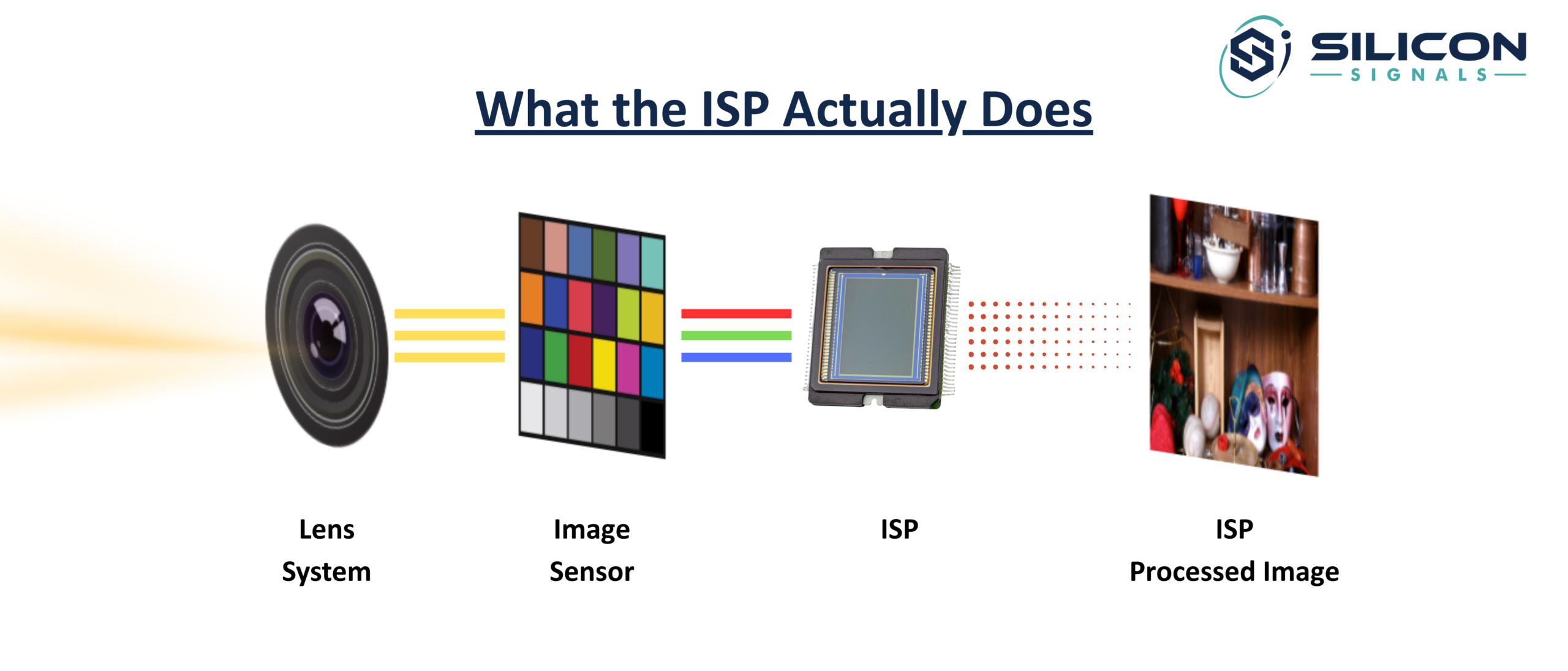
What the ISP Actually Does
Three fundamental components that compose every camera:
- Lens
- Image Sensor
- ISP (Image Signals Processing)
The ISP is the brain of the system. It turns raw sensor data that is noisy and looks like grayscale into
clear, color-accurate images that can be understood.
The pipeline has the following things:
- Demosaicing
- Noise reduction
- Sharpening
- Auto exposure
- Auto focus
- Auto white balance
- Lens shading correction
- HDR merge
- Color correction
- Gamma mapping
- Temporal filtering
There are dozens of parameters in each block. Changing one thing often changes a lot of other things.
Camera design engineers spend weeks calibrating these settings for each lighting situation because even one wrong
setting can mess up the whole thing and make the final output worse.
In short, tuning is not optional; it’s what makes a camera “work” or “perform.”
How Cameras “See” Color Using the Bayer Pattern
Most image sensors don’t directly capture color. They only check how bright it is. A Bayer filter assigns each pixel to red, green, or blue to make color. Then, the ISP uses an algorithm called demosaicing to fill in themissing colors.
It’s a smart system, but it’s also weak. Artifacts can happen because of noise, wrong calibration, or bad demosaicing:
- Moiré
- Color fringing
- Blockiness
- False edges
This is why you need to tune in. If the demosaicing and color pipeline aren’t set up right, you can have the best sensor money can buy and still get bad pictures.
Imaging Algorithms: The Real Workhorses
The camera uses more than just basic ISP blocks:
- 3A (AE, AWB, AF)
- Low-light enhancement
- HDR merge
- EIS (Electronic Image Stabilization)
- Super-resolution
- Depth estimation for ToF or stereo
- Spatial and temporal noise reduction
Tuning is necessary for each algorithm. For instance:
Auto White Balance
Without tuning, AWB can make skin tones look blueish outside, yellowish inside, or different from frame to frame.
HDR
When HDR is not set up correctly, it can make moving objects look like they have halos or ghosting around them, or it can make contrast look flat in a way that isn’t natural.
Low-Light Enhancement
Bad tuning takes away texture or adds loud noise patterns.
These things are important. This is especially true in fields where the accuracy of images affects safety, compliance, or business results.
Surveillance Camera Tuning
The reliability and consistency of the camera are what make surveillance systems work. The camera has to work in all kinds of lighting, weather, and motion conditions, whether it’s watching a factory floor, recognizing faces at a mall entrance, or reading license plates on a highway. That’s when tuning really makes a difference. It turns a raw camera module into a reliable security tool, which is exactly what specialized camera design engineering services and camera design engineering solutions do.
On the outside, an IP surveillance camera looks simple, but on the inside, it needs a lot of things. It has to:
- Take clear pictures of text, like license plates
- Stay steady in bright sunlight, cloudy skies, artificial light indoors, and almost complete darkness.
- To help with forensic analysis, reproduce colors accurately.
- Keep important texture while controlling noise at night
- Control motion in scenes where people, cars, or animals move in ways that are hard to predict.
- Take care of the changes between lighting zones, like parking lots, tunnels, and street corners.
To do this, each ISP block needs to be carefully tuned and tested over and over again. Here is a clearer explanation of what happens during a surveillance camera tuning cycle.
3A Tuning: Getting the Camera’s “Autopilot” Under Control
The first thing to do is to make sure that Auto Exposure, Auto Focus, and Auto White Balance are all stable. This is what lets the camera respond smartly to what’s going on in the real world.
- AE needs to be able to deal with sudden changes in brightness without making highlights too bright.
- AF needs to focus on moving things, not the background.
- AWB needs to make sure that skin tones, uniforms, and vehicle colors stay the same under LEDs, sodium lamps, or mixed lighting.
If 3A isn’t set up right, every part of the ISP gets worse. This is why professional camera design and engineering services always start here before making more changes.
Objective Tuning: Science and Controlled Calibration
When 3A works reliably, engineers go into the lab to make the camera pipeline’s mathematical backbone. They measure with X-rite charts, ISO resolution charts, lux meters, uniform lights, and setups that keep the temperature stable.
- Sensor noise and dark current
- Lens shading and distortion
- Color matrices and white balance references
- HDR merge behavior
The lighting is simulated from 1 to 10,000 lux and from 2000K to 7500K. This stops people from having to guess and try things out. This phase is very important for strong camera design engineering solutions to get professional surveillance-grade output.
Subjective Tuning: Real-World Validation
Now that the camera has a solid base, it is put to the test outside, where surveillance systems really work. Engineers check how well things work on streets, in hallways, parking lots, fog, shadows, neon signs, and low-light traffic.
They look at:
- Natural colors
- Texture retention
- Shadow detail
- Facial tone accuracy
- Artifacts like moiré or ghosting
- White balance consistency
- Readability of plates, text, and logos
Charts can’t show everything, so subjective refinement goes on until the camera works the same way in real life.
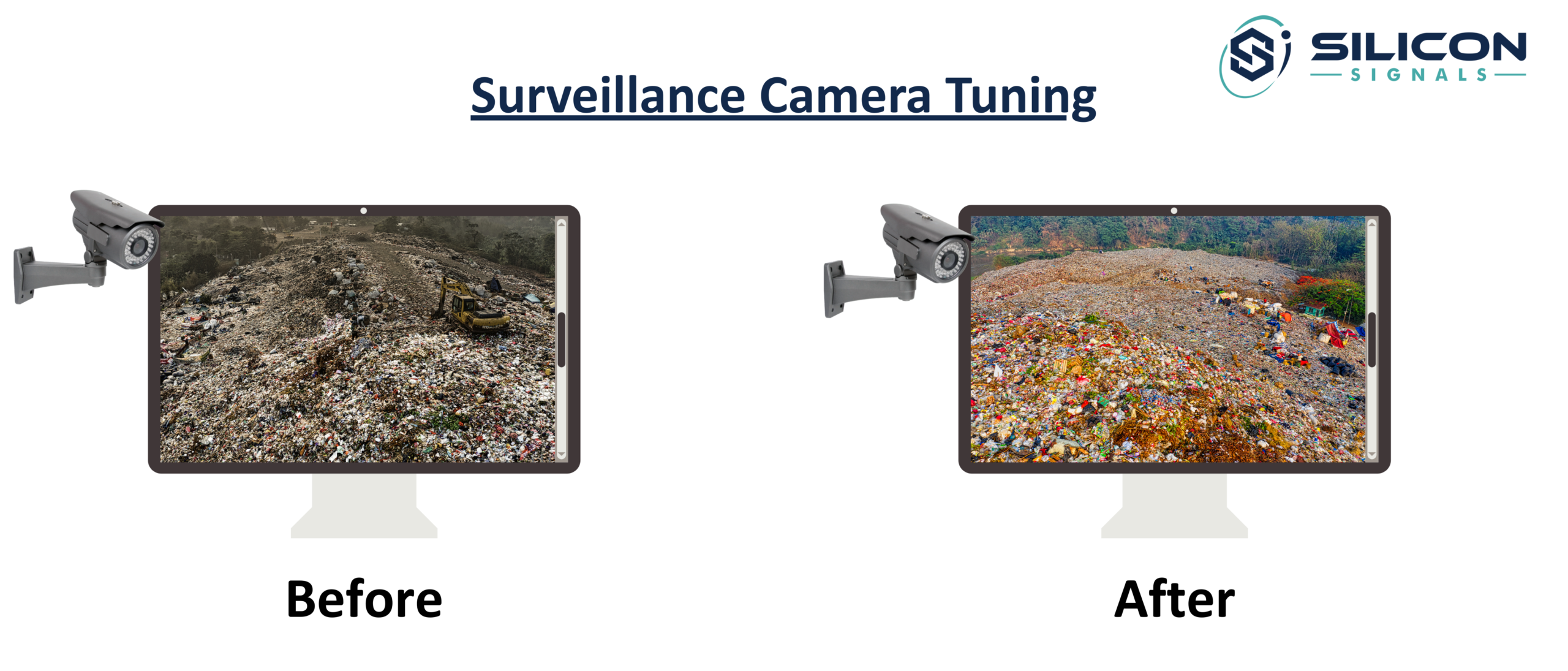
Image Quality Benchmarking: The Final Check
Finally, the tuned camera is compared to well-known leaders in the field. Engineers examine:
- Day and night clarity
- IR and noise performance
- Motion handling
- HDR stability
- Color and AWB accuracy
- Overall dynamic range
The goal isn’t just to “look good,” but also to make sure that the camera can be trusted in real-world situations and meets the standards for competitive surveillance.
Ready to build a surveillance camera that delivers consistent, reliable image quality?
Objective Measurements: Where Precision Begins
Engineers collect basic metrics before tuning even begins. These are the basic parts you need to calibrate ISP blocks correctly. The key measurements include:
Sensor-Level Data
- Dark current
- Signal-to-noise ratio
- Gain-dependent noise models
Lens and Optics
- Distortion curves
- Shading maps
- Optical center offset
Color and Light Response
- RGB color conversion matrices
- AWB reference calibration points
- Tone-mapping curves for HDR
This step makes sure that the ISP starts with the right math. If these values are wrong, every step of the tuning process that comes after it will also be wrong.
Why This Level of Detail Matters for Surveillance
Surveillance people isn’t the same as taking pictures. It’s not about making the scene “pretty.” It’s about making it useful:
- Law enforcement officers need to be able to read license plates and recognize people’s faces.
- AI models need to be able to reliably track individuals, vehicles, and behaviors.
- For incident review, security teams need stable color and exposure.
- Cameras that work well in the sun, shade, and total darkness are important for businesses.
This calls for a camera pipeline that has been set up with both scientific accuracy and human judgment. And this is where professional camera design engineering services and camera design engineering solutions really come in handy.
How Companies Handle Tuning
Companies like Silicon Signals that design and build cameras deal with tuning problems in a wide range of situations:
- Industrial cameras for seeing machines
If AI is slightly out of tune, it can misclassify things, which can lead to false rejections on production lines.
- Smart systems for watching over things
Silicon Signals often help clients who need reliable performance day and night, IR tuning, and accurate color reproduction for for forensic work.
- Robots and drones
Latency, AWB speed, and HDR accuracy are important here because flight algorithms need stable images.
- Automotive and ADAS
Calibration needs to be very precise for glare, flicker fusion, dynamic range, and motion handling.
- Consumer Devices
Tuning makes the difference between a bad and a great user experience in products like doorbell cameras, home assistants, and handheld devices.
The company’s camera design engineering solutions for these projects include setting up the ISP, creating algorithms, validating them both objectively and subjectively, and doing final benchmarking before deployment.
What this really means is that good imaging isn’t a matter of luck; it’s planned.
So Why Is Tuning So Critical?
Here’s what you need to know: A camera that isn’t tuned well is like a fast car with flat tires. The hardware might be great, but the output is very bad.
Tuning and validation make sure that:
- The camera remains consistent
- AI/ML models receive usable data
- Color looks natural
- Textures stay intact
- Details survive shadows and highlights
- The device behaves predictably across lighting conditions
Thoughtful engineering helps every part of the imaging pipeline. As devices get smarter, more connected, and more reliant on AI, the need for high-quality image data will only grow.
Conclusion
A surveillance camera is only as good as how well it is set up. Just having the right hardware won’t make things clear, stable, or consistent. How well each ISP block, algorithm, and control loop is set up to work in the real world affects the quality of the image. This is the point at which the difference between “a camera that works” and “a camera you can trust” is made.
Companies like Silicon Signals have a lot of experience with ISP tuning, sensor calibration, HDR optimization, IR performance, and testing things in the real world. Their camera design engineering services and camera design engineering solutions help businesses make surveillance systems that work well and give clear images all the time, inside and outside, and anywhere else.
