

Core Software Layers Inside a Board Support Package
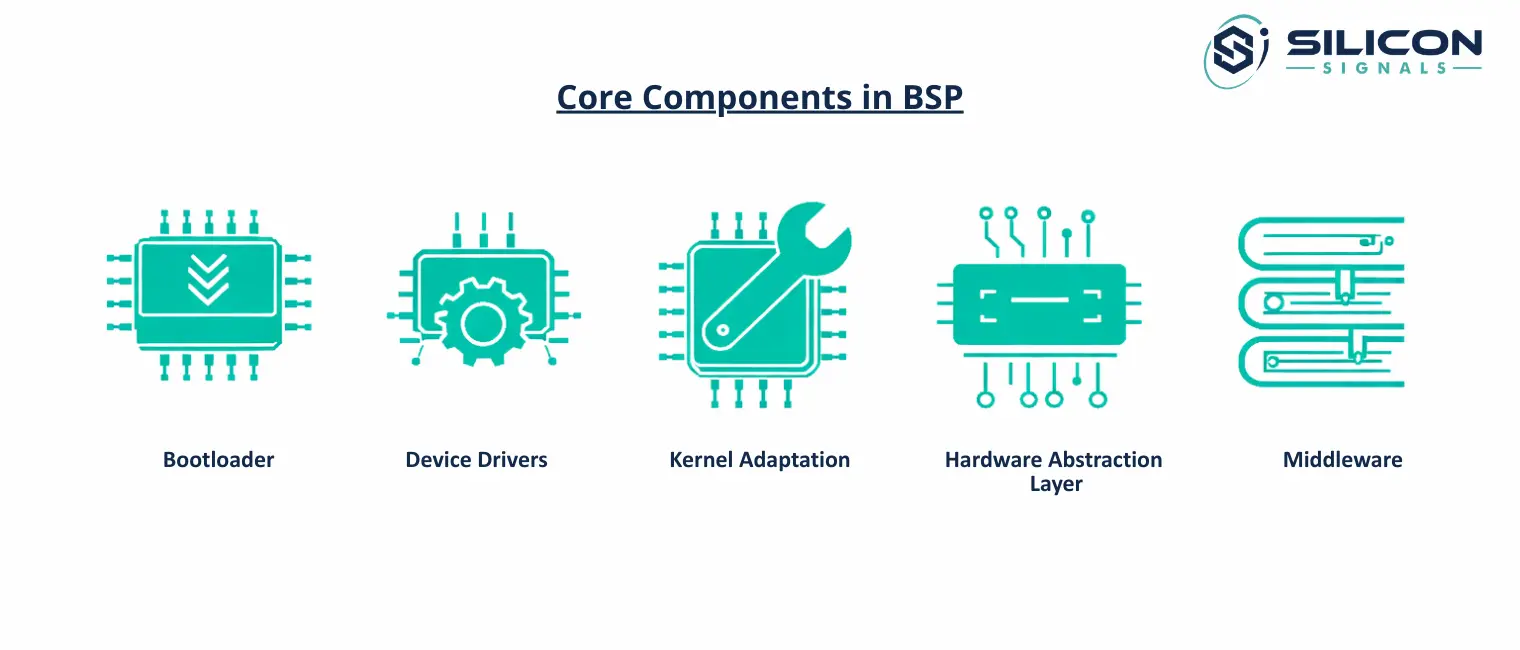
A BSP contains several interconnected components that together allow the operating system to run on the hardware platform.
Bootloader and System Initialization
The bootloader is the first program executed during system boot-up. The bootloader is responsible for initializing the CPU and loading the operating system kernel into memory.
Bootloaders are also responsible for system recovery and updating. Embedded systems often utilize U-Boot bootloaders due to their ability to provide flexible boot configurations, secure boot, and hardware initialization.
System initialization code is responsible for initializing clocks, memory, power domains, and peripheral buses before executing the OS.
Without proper initialization code, it is impossible to execute the operating system.
Device Drivers
Device drivers act as the interface between the operating system and hardware devices connected to the board.
All peripheral devices need to be connected with a driver that acts as a bridge between operating system instructions and hardware instructions.
Device drivers handle communications with displays, sensors, network devices, storage devices, and other hardware communications such as I2C, SPI, UART, and PCIe.
Writing drivers is often the most time-consuming part of creating a custom BSP development because each hardware component needs to be tuned and validated.
Kernel Adaptation
The kernel of the operating system has to be adapted or modified in many cases to accommodate the specific hardware architectures.
Adaptation of the kernel may include the enablement of processor features, the addition of device drivers, interrupt handling, and scheduling optimization.
For Linux-based systems, kernel adaptation may include the modification of the device tree files, which contain information on the hardware layout and connections.
Hardware Abstraction Layer
The hardware abstraction layer eases interaction between software at a high level and hardware.
The HAL replaces the need for applications to directly interact with low-level hardware registers.
The HAL provides software with a set of standardized APIs to interact with hardware functionality.
This abstraction eases application development and enhances software portability between different hardware platforms.
Peripheral Libraries and Middleware
BSPs may also include peripheral libraries and middleware that offer easier access to hardware capabilities.
This may include networking stacks, multimedia libraries, communication stacks, and graphics libraries.
Middleware is used in BSPs to assist application programmers in creating application features without having to worry about hardware details.
Why Custom BSP Development Matters
Many organizations don’t realize the value of BSP development until they face hardware compatibility issues.
Custom BSP development is vital to ensure that an embedded system works efficiently and effectively.
One of the main benefits of BSP is hardware abstraction. Hardware abstraction is a technique that separates hardware-dependent code from application code and provides a layer of abstraction to allow developers to work on product development instead of hardware-dependent code.
Another significant advantage of BSP is that it provides a facility to customize. Embedded systems are composed of a variety of hardware resources such as processors, memory, and peripherals. A custom BSP provides a facility to exploit all hardware resources.
Performance optimization is also possible with BSP. BSP provides a facility to optimize hardware resources to perform efficiently.
Reliability is another factor to be considered. Embedded systems may be used in critical applications like industrial control systems, automotive systems, or medical devices. A reliable BSP minimizes system failures owing to hardware compatibility problems.
Scalability is an important factor to be considered. With advances in hardware technology, it is possible to update the BSP to support new hardware configurations while retaining software compatibility.
Security is also an important factor to be considered. Secure boot is typically implemented at the BSP level.
The BSP Development Lifecycle
To develop a Board Support Package, it is necessary to have hardware and operating system expertise. The development of a BSP usually involves a number of steps, which start from hardware and end at maintenance.
Hardware Platform Analysis
The first step is to understand the hardware.
This involves studying the processor manual, memory configuration, peripheral interfaces, and board schematics. All this information is essential to understand how the operating system should behave with the hardware. This step is necessary to analyze all system components.
BSP Architecture Design
Once the hardware platform is understood, the BSP architecture is designed.
This step includes designing the bootloader configuration, how the kernel is integrated into the BSP, and what drivers and middleware are required. It is also in this step that hardware is exposed to the operating system.
Driver Development and Integration
Device drivers are next created or modified to support hardware peripherals. Driver development may include programming at the register level and communication protocols. Testing is performed at this step to ensure peripherals work and behave well with the operating system.
Kernel Configuration and Integration
Kernel configuration is next performed. This includes enabling processor features, integrating drivers into the kernel, and defining hardware topology through configuration files. Scheduling and memory management behavior and interrupt handling are also configured.
System Testing and Validation
After the BSP has been built, it must be thoroughly validated.
Testing involves boot sequence testing, peripheral testing, system stability testing, and performance testing with various workload scenarios. Hardware stress testing and environmental testing might be needed for industrial or automotive products.
Maintenance and Long-Term Support
Typically, products created for embedded systems must be supported for many years. Maintenance of BSP includes drivers, bug fixes, security patches, and making modifications to BSP for new hardware revisions.
BSP support is essential for product reliability and product lifecycle management.
BSP Development Tools and Ecosystems
Development of BSPs demands a specific toolchain and development environment.
Cross-compilers are necessary to develop software for architectures different from those of the development workstation.
Debuggers are necessary to analyze system behavior and track errors during system boot and runtime. Development environments are necessary to manage code, build processes, and debug processes.
One popular toolchain available for developing Linux-based embedded systems is called Yocto Project. Yocto Project is a collection of tools and templates necessary to develop customized Linux distributions based on specific hardware platforms.
Yocto Project is necessary to develop customized system packages, kernel configurations, and build environments according to system requirements. Depending on the specific processor architectures, various toolchains and development environments are available.
Challenges in BSP Development
BSP development, despite its criticality, is still one of the most technically challenging activities in the design of an embedded system.
The hardware documentation may not be comprehensive or may even include inconsistencies, which makes driver development difficult. Debugging of early boot code may not always be easy due to a lack of functionality prior to the operation of the operating system.
There may be compatibility problems in kernel versions and hardware drivers, leading to integration problems.
Power management and thermal optimization may require careful tuning, especially for battery-powered devices.
Security aspects may add an additional dimension of complexity to the design process, considering the implementation of secure boot and trusted execution environments.
Conclusion: The Strategic Role of BSP Development in Embedded Products
Board Support Package development is the cornerstone on which embedded systems are built. It is a mechanism that allows operating systems to communicate with hardware platforms and also guarantees that all processors and memory components are working in tandem.
For any company that specializes in creating custom electronic products, BSP development is not just a matter of creating code. It is a significant aspect of any product that is created.
A BSP is a mechanism that guarantees that any embedded system is able to grow and change in tandem with hardware and also guarantees that it is secure.
Any company that specializes in creating embedded products requires a high level of expertise in this area. It is in this area that any company can offer value.
Silicon Signals assists product development teams in creating production-ready embedded systems with its custom BSP development for embedded systems, hardware development, Linux platform enablement, and driver development. Silicon Signals helps organizations unlock complex hardware platforms with its solutions, which ensure the reliable interaction of software and hardware right from the beginning of product development.
For product development teams designing new embedded systems or modifying existing ones, creating a well-engineered BSP is the critical step required to transform the hardware prototype into a working product, ready for deployment.
