
CBU vs CKD vs SKD in CCTV Manufacturing Explained

Table of Contents

Introduction

Ultimately, every CCTV brand must choose among three manufacturing approaches: importing complete cameras, assembling imported components locally, or manufacturing and assembling the product locally. This decision directly affects pricing, regulatory compliance, and the level of long-term control over the product.

A brand aiming to grow beyond fundamental CCTV reselling needs to understand intelligent vision solutions and SKD CKD IP camera manufacturing. It must also understand the difference between OEM and ODM manufacturing to determine how much control it will retain over the product’s design and technology.

Understanding CBU, CKD, and SKD Manufacturing Models

CBU, CKD, and SKD refer to the different assembly processes done before a camera is sold in the retail market. Each model has its own cost balance with regard to control and compliance.

What Is CBU (Completely Built Unit) Manufacturing?

CBU manufacturing involves importing an IP camera as a completely built-up, tested, and packaged product from the source factory. The only thing done locally is the distribution. The unit is ready to go with a sensor, processor, housing, lens, and firmware all integrated and calibrated.

For brands that use the CBU model, they are actually more of a marketer and less of a manufacturer. CBU is the best option for a company looking to enter the surveillance market quickly and without any local production capability. It is important to note that this model also provides the least amount of flexibility to adjust to local preferences.

What Is CKD (Completely Knocked Down) Manufacturing?

CKD manufacturing involves importing the camera as separate components or subcomponents and carrying out the complete assembly process locally. An image sensor, PCB, lens barrel, housing shell, and connectors are all assembled locally. This technically is not fully manufactured.

Each of these components is assembled from the ground up on a CKD production line. This line performs soldering, calibration, firmware loading, and then does the quality control. This type of manufacturing requires real investment, but the manufacturer keeps full control of the production.

What Is SKD (Semi-Knocked Down) Manufacturing?

This is the middle option of the three. SKD manufacturing involves importing partially assembled subassemblies. The PCB may arrive populated, while mechanical assembly, lens installation, firmware loading, branding, calibration, and final testing are completed locally.

SKD camera manufacturing usually consists of receiving SKD sub-assemblies, doing the mechanical assembly, performing functional tests, and performing local firmware changes and unit branding before the unit gets shipped. This is less of a technical risk than CKD, but more value can be added than with imported manufacturing.

Key Components Used in SKD and CKD IP Camera Manufacturing

Every SKD CKD IP camera build depends on a defined set of sourced components that determine performance, cost, and reliability.

Camera image sensor
  • Sony sensors remain the benchmark for low-light performance and color accuracy in surveillance-grade cameras.
  • OmniVision sensors are widely used in cost-sensitive CKD IP camera builds where price competitiveness matters.
  • ON Semiconductor sensors are common in industrial and specialized surveillance applications requiring specific spectral response.
Processing and storage components
  • The ISP side takes care of the image signal processing. It then creates video output from the raw sensor data.
  • The SoC is responsible for video encoding, neural network inference, and intelligent systems on the IP camera.
  • Memory modules support real-time buffering and firmware execution during camera operation.
  • Storage devices, including microSD slots or onboard flash, enable edge recording without cloud dependency.
Mechanical components
  • The camera housing protects the internal electronics and determines the IP rating, which determines the level of protection from moisture and dust for outdoor deployments.
  • The lens assembly affects optical quality and controls focal length and field of view in captured footage.
  • Heat sinks deal with thermal dissipation for processors that continuously encode video.
Connectivity components
  • Ethernet interface supports wired data transmission and PoE-based power delivery.
  • PoE modules eliminate the need for separate power cabling during installation.
  • Wi-Fi modules enable wireless deployment where structured cabling is impractical.
  • Antennas affect signal range and reliability in wireless IP camera configurations.
Looking to launch your own CCTV brand?
Explore our CBU, SKD, and CKD IP camera manufacturing solutions designed for OEM and ODM partners.

CBU vs CKD vs SKD: Understanding the Differences

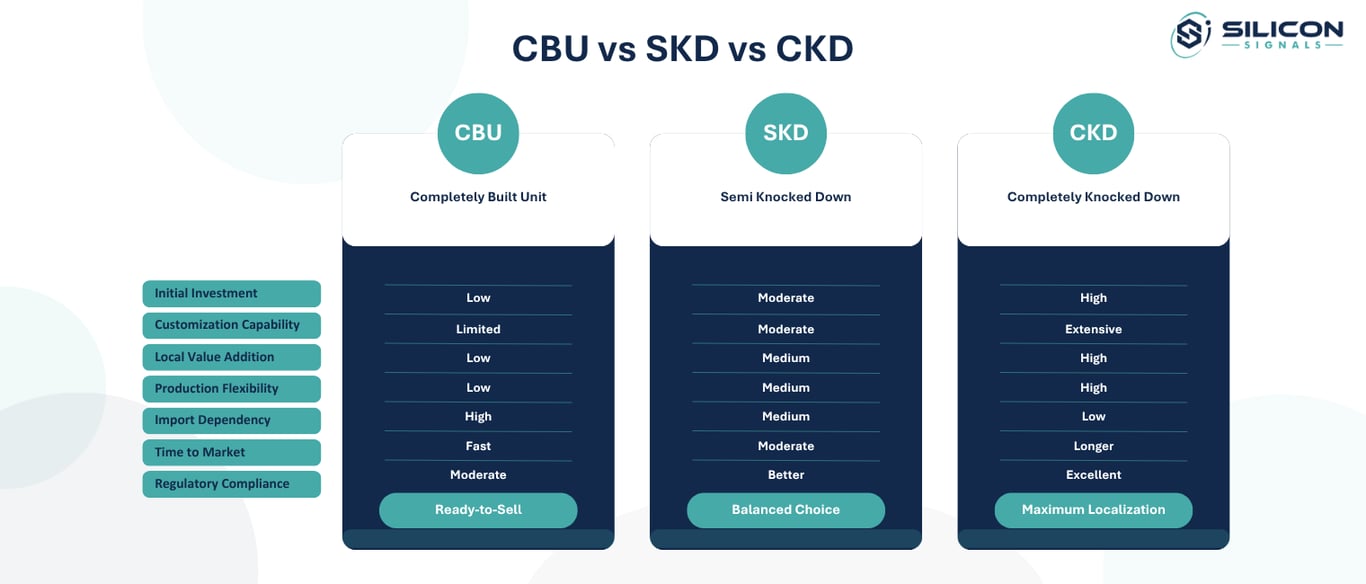
Assembly depth, capital cost, and how much local regulatory credit a manufacturer receives are the three main ways these three models differ. These differences have a direct impact on margins and market positioning.

Assembly process comparison

CBU units do not require local assembly because they are shipped as fully assembled products. SKD (Semi-Knocked-Down) manufacturing requires local assembly for some mechanical integration and testing. CKD (Completely Knocked Down) manufacturing requires complete assembly of the unit and even requires the capability to populate the PCB in some advanced manufacturing setups. Hence, CKD manufacturing is the most labor- and process-intensive among the three.

Investment requirements

CBU manufacturing requires the least investment since there is no manufacturing capability (line) to build. SKD involves moderate investment in assembly tooling, testing equipment, and employment of skilled technicians. CKD requires the most investment among the three, as it involves the establishment of an SMT line, calibration equipment, and QC infrastructure for a complete IP (Internet Protocol) camera manufacturing setup.

Supply chain complexity

CBU offers the simplest supply chain, requiring only the purchase of a fully assembled finished product. SKD has a moderate supply chain complexity because of the need for sub-assemblies and local component sourcing. CKD (completely knock-down) is the most difficult supply chain to manage since we have to deal with multiple vendors for components, maintain several inventories of parts, and ensure controlled quality among suppliers.

Compliance and regulatory considerations

Several countries offer preferential duty structures and local value-addition credits depending on the depth of assembly. CKD and SKD manufacturing may offer greater local value addition than CBU imports, but the applicable duty structures, incentives, and compliance benefits depend on the destination country and its current regulations.

CBU vs CKD vs SKD Comparison Table

Manufacturing model comparison
Advantages of CBU Model

CBU manufacturing works best for brands prioritizing speed over control. It removes production complexity entirely, letting a company focus purely on sales and distribution.

Faster market entry

Finished units can reach shelves within weeks of order placement, with no assembly line setup required beforehand.

Lower infrastructure investment

There is no need for factory space, assembly equipment, or trained production staff to launch a CBU camera line.

Simplified logistics and operations

A single import shipment replaces the need to coordinate multiple component vendors and assembly schedules.

Reduced workforce requirements

Operations stay lean since the business needs sales and support staff rather than technicians or engineers.

Advantages of CBU Model

The CBU model has upsides, but also drawbacks such as reduced flexibility and potentially lower long-term competitiveness in the market down the road.

Limited customization opportunities

Brands can’t choose their firmware, the design of the case, or which components they want; those decisions are typically finalized before the product reaches the brand.

Greater dependence on external suppliers

For internationally sourced units, pricing may be affected by currency fluctuations and longer logistics timelines.

Increased regulatory risks

CBU products may face less favorable duty structures or procurement limitations in markets that prioritize local sourcing and assembly.

Lower control over product quality

The local brand has no recourse when the quality of the product is questioned because any defects show up post-manufacturing and are traced back to the original factory.

Advantages of SKD Model

SKD is an attractive option for brands looking to manufacture their products through a partnership while maintaining cost control.

Reduced production costs

Partial local assembly lowers landed cost compared to importing fully finished units at CBU pricing.

Greater product customization

Local final assembly allows adjustments to housing, branding, and firmware before the camera ships.

Better supply chain flexibility

Leveraging multiple suppliers for subassemblies builds redundancy with multiple foreign factories.

Easier compliance with local regulations

SKD camera manufacturing typically qualifies for better duty structures than CBU under most localization frameworks.

Disadvantages of SKD Model

SKD adds some friction, and brands need to plan additional operational demands caused by added complexity.

Moderate capital investment

Assembly tooling and testing equipment require upfront spending beyond what CBU distribution needs.

More complex inventory management

Tracking sub-assemblies alongside mechanical parts adds a layer of planning that CBU does not require.

Additional testing requirements

Each unit needs functional testing after local assembly to confirm performance before shipment.

Skilled workforce requirements

Technicians must understand calibration, firmware flashing, and quality inspection procedures.

Advantages of CKD Model

CKD manufacturing offers the deepest level of control, suited to brands building long-term surveillance product lines.

Maximum localization benefits

Full local assembly typically unlocks the strongest duty exemptions and government incentive programs.

Complete control over product quality

Every stage, from PCB population to final calibration, happens under the manufacturer’s direct oversight.

Higher profit margins

Eliminating finished-goods import markup allows CKD IP camera producers to capture more value per unit.

Stronger brand positioning

True local manufacturing supports claims of domestic production, which matters in government and enterprise tenders.

Disadvantages of CKD Model

The control CKD offers comes with real operational demands that smaller brands may not be ready for.

Higher operational complexity

When you want to run a full assembly line, you need to have an integrated plan that includes your manufacturing, supply, and quality assurance teams.

Longer production cycles

Building from raw components takes more time than final assembly of pre-built sub-units.

Increased investment in equipment

SMT lines, reflow ovens, and test benches represent significant capital compared to SKD or CBU setups.

Greater supply chain management challenges

Coordinating dozens of component vendors introduces more points of potential delay or quality variance.

How OEM CCTV Manufacturing Fits into the Process

OEM CCTV manufacturing lets a brand sell cameras built by another company under its own name, without owning the underlying design.

Understanding OEM CCTV manufacturing

An OEM partner manufactures the camera based on existing designs, and the client brand applies its own labeling and packaging.

Benefits of OEM-based production

This route avoids design and engineering costs entirely, letting a brand launch a product line using proven hardware.

When brands should choose OEM partnerships

OEM works well for companies focused on distribution and marketing rather than hardware engineering or firmware development.

Custom branding and packaging capabilities

Most OEM CCTV manufacturing partners provide end-to-end camera design support, including logo placement, custom packaging, and minor modifications to the camera housing

Need a trusted manufacturing partner?
Contact our team to build customized, STQC-ready surveillance solutions tailored to your market.

How ODM CCTV Manufacturing Differs from OEM Manufacturing

ODM CCTV manufacturing involves a partner designing the product from the ground up based on the client’s specifications.

What is ODM manufacturing?

An ODM partner will handle hardware design, firmware development, and manufacturing. This will provide a product tailored to the client’s needs.

Product ownership and intellectual property

Depending on the agreement, ODM projects can give the client brand partial or full ownership of the resulting design.

Design customization capabilities

ODM allows changes to sensor selection, processing architecture, housing design, and firmware features from the earliest stage.

Selecting the right manufacturing partner

When selecting the best CCTV design company, brands should evaluate engineering expertise, manufacturing capabilities, compliance experience, and after-sales support.

Which Manufacturing Model Is Best for Your CCTV Business?

The right model depends on business stage, available capital, and how much control a brand needs over its product.

Best applications for CBU manufacturing
  • Small distributors benefit from CBU when testing market demand without upfront production commitment.
  • System integrators often prefer CBU for project-based deployments where volume does not justify local assembly.
  • Startups use CBU to validate a product line before investing in SKD or CKD infrastructure.
Best applications for SKD manufacturing
  • As volume increases, more surveillance brands start using SKD for local assembly, while full CKD remains a future investment.
  • Regional manufacturers use SKD to localize their product with limited capital.
  • White-label CCTV businesses rely on SKD to balance customization with manageable operational complexity.
Best applications for CKD manufacturing
  • Large businesses go with local manufacturing when the volume and margin warrant complete CKD IP camera production.
  • CKD level localization is often necessary when government projects require compliance with procurement, local sourcing, and assembly requirements.
  • CKD allows International OEMs to manufacture components locally for regional manufacturing to serve markets that are further away.

The Future of SKD and CKD IP Camera Manufacturing

Localization pressure and evolving compliance standards are reshaping how surveillance brands approach manufacturing decisions.

Increasing localization initiatives

Government policies across several regions now favor CKD and SKD production through duty structures and procurement preferences.

Growing demand for STQC-compliant products

Security certification requirements are pushing manufacturers toward local testing and validation as part of the SKD or CKD workflow, particularly for STQC-aligned IP surveillance camera solutions.

AI-powered camera manufacturing

On-device analytics and edge processing are adding new components to CKD IP camera builds, including dedicated AI accelerators.

Expansion of white-label and private-label surveillance brands

More companies are entering the market through SKD partnerships, using local assembly to build brand identity without full CKD investment.

Conclusion

When choosing between CBU, SKD, and CKD production models for IP cameras, brands should consider their desired level of product control, available investment, localization objectives, regulatory requirements, and expected production volume. As a camera design and manufacturing partner, Silicon Signals supports surveillance brands across OEM and ODM partnerships, as well as CBU, SKD, and CKD production models, from component selection and product design to testing and manufacturing. Brands can contact Silicon Signals to identify the model that best aligns with their product roadmap and long-term business objectives.

About the Author

Picture of Mitul Tank
Mitul Tank
Mitul Tank brings 12+ years of product development expertise, specializing in embedded vision and camera systems. He delivers solutions across architecture design, image pipeline optimization, BOM cost reduction, and multilayer PCB design taking products from concept to mass production.