

Why Camera Performance Is an Engineering Problem, Not a Sensor Problem
There are cameras everywhere now. Surveillance systems keep an eye on cities and factories. Cameras help keep drivers safe in cars. Drones can map land, check on assets, and collect data from the air. Imaging is important for medical devices to make diagnoses. In the real world, though, these cameras act very differently even though they use the same sensors.
Some have trouble in low light. Some don’t work when they move. In the lab, some look fine, but they fall apart outside. The sensor alone doesn’t make much of a difference. It all comes down to how the camera is designed.
Statista and Yole Intelligence say that the global image sensor market has grown to more than USD 23 billion in recent years, mostly because of growth in the automotive, surveillance, and industrial vision markets. But reports of industry failures tell a similar story. A lot of camera-based products have performance problems after they are put into use. Most of these problems are due to bad system-level design choices, not broken parts.
Camera design engineering services are important because they help close the gap between what sensors can do and how well they work in the real world. This is where raw imaging hardware becomes a dependable system. And this is where thoughtful camera design engineering solutions quietly choose whether a product does well or poorly.
Let’s break it down the right way.
What Camera Design Engineering Really Means
This is the thing. It’s not just about picking a sensor and connecting it to a processor when it comes to camera design engineering. It’s a discipline of the system.
It talks about how light gets into the camera, how that light is turned into electrical signals, how those signals are processed, and how the final image looks in real life, such as when there is glare, vibration, heat, motion, or changing light.
At its most basic level, camera design engineering is the process of bringing together:
- Optical design
- Sensor selection and configuration
- ISP tuning and image processing
- Hardware and PCB design
- Firmware and driver integration
- Mechanical and thermal considerations
- Validation against real-world use cases
Each layer has an effect on the next. If you ignore one, your performance will drop in another area.
That’s why experienced camera design engineering services always work on the whole stack instead of just treating the camera as a plug-and-play module.
Why Camera Performance Still Breaks in the Field
Let’s see what the data and real-world experience say.
Surveys of the industry by groups like Omdia and Frost & Sullivan show that complaints about picture quality are still one of the main reasons why people return surveillance and automotive camera products. The top problems are low-light failure, color inconsistency, motion blur, and unstable exposure.
It’s easy to understand what this means. Most failures are not caused by sensors. They are failures in engineering.
If the lens, ISP configuration, and exposure strategy don’t work well together, a sensor that is rated for excellent low-light performance will still make noisy images. If motion handling and frame timing aren’t set up right, a high-resolution sensor will still miss details.
This is why improving performance is more about engineering than upgrading parts.
How a Camera Actually Works: From Light to Image
It helps to know how a camera really works before talking about how to make it work better. Not in theory, but in practice.
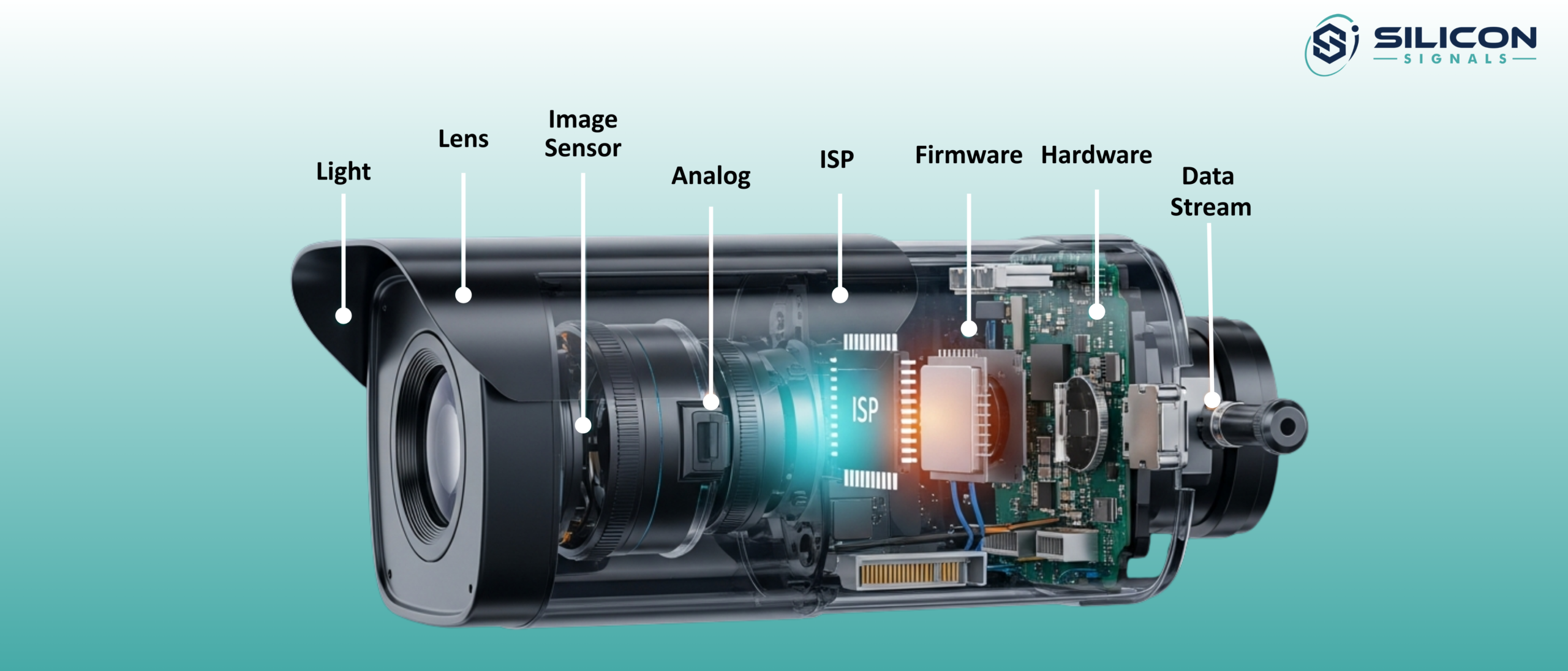
Camera Signal Flow
You can think of a camera system as a pipeline with clear steps:
- Scene and Light
Light from the real world bounces off things and into the camera.
- Lens Assembly
The lens directs light to the sensor. Here, aperture, focal length, distortion, and alignment all matter.
- Image Sensor
The sensor turns light into electrical signals. The quality of the raw data is determined by the pixel size, color filter array, and sensitivity.
- Analog Front End
The signals are made stronger and turned into digital signals. This is where you start to deal with noise.
- Image Signal Processor (ISP)
This is where you do tone mapping, demosaicing, noise reduction, HDR, color correction, and sharpening.
- Firmware and Drivers
You can change the exposure, gain, frame timing, and sensor behavior in real time.
- Output Interface
Video or picture data is sent to storage, display, or AI processing.
You can find the cause of every performance problem in one or more steps of this flow. Instead of focusing on just one block, good camera design engineering solutions make the whole pipeline work better.
Struggling with inconsistent image quality across lighting and motion conditions?
Sensor Selection Is Only the Starting Point
It’s important to choose the right sensor, but that’s not all you need to do.
Different uses need sensors with different features. Cameras for surveillance put low-light sensitivity and dynamic range first. Automotive cameras are built to work quickly and reliably in tough situations. Industrial cameras might put global shutter behavior ahead of resolution.
Camera design engineering looks at sensors in terms of:
- Pixel size and sensitivity
- Rolling vs Global Shutter Behavior
- Dynamic range characteristics
- Noise Profile
- Temperature Stability
- Long-term Availability
But the most important thing to remember is this. The performance of a sensor’s datasheet only becomes real when it is backed up by the right optics, ISP tuning, and firmware control. This is where camera design engineering services really help.
Optics: The Silent Performance Multiplier
People often don’t give optics enough credit. But the quality of an image can depend on the lens you choose.
A bad lens can cause distortion, chromatic aberration, flare, and uneven lighting. No amount of ISP tuning can completely fix that. Good camera design engineering sees optics as a part of the system, not something to buy.
Engineers look at:
- Trade-offs between field of view and distortion
- Aperture size vs. depth of field
- Filtering infrared light and responding to different wavelengths
- Tolerances for mechanical alignment
- Durability in the environment
When optics and sensors are designed together, the quality of the images gets better before any software does anything with the data. That’s one of the best things about professional camera design engineering solutions that people don’t talk about enough.
ISP Tuning: Where Performance Is Won or Lost
This is where most camera projects either do well or fail without anyone noticing. The Image Signal Processor does a lot more than just turn raw data into a picture. It tells the camera how to act when it’s under stress.
The right ISP tuning adjusts:
- Auto exposure response when the light changes
- Auto white balance stability
- Noise reduction without detail loss
- Motion Handling and Temporal Filtering
- HDR merging and tone curves
- Color accuracy in different light conditions
The default settings for ISPs are not specific. They are meant to work pretty well in a lot of situations, not perfectly in one. Professional camera design engineering services put a lot of work into adjusting ISP settings to fit the product’s environment and use case. This alone can make the picture look much better without changing the hardware.
Firmware Control: Making the Camera Predictable
A lot of teams learn this the hard way. A camera that looks good but doesn’t work right is a problem. The firmware controls how the camera works over time. Sudden changes in exposure, focus that takes too long, and color shifts that aren’t always the same. These are not sensor problems; they are firmware problems.
Camera design engineering makes sure that firmware:
- Controls the timing of the sensor exactly
- Handles edge cases like flickering and quick changes in light
- Keeps frame rates steady
- Works well with systems that come after it
When firmware is seen as a key part of camera design, the camera works well all the time, not just in demos.
Thermal and Mechanical Design: Performance Under Pressure
In most cases, cameras don’t work well. It’s common for things to get hot, vibrate, get dusty, and get wet. Thermal problems can lower image quality by making sensor noise worse and changing how colors respond. If the parts aren’t lined up correctly, the focus and sharpness can slowly get worse.
Camera design engineering solves this by:
- Making sure that thermal paths are right
- Choosing materials that maintain alignment
- Testing performance at different temperatures
- Stress testing in real-world situations
This is especially important for industrial, automotive, and outdoor surveillance systems, where performance needs to stay the same for years.
Camera Applications Explained Through Engineering Needs
Let’s talk about where cameras are used and how design engineering affects performance in each case.
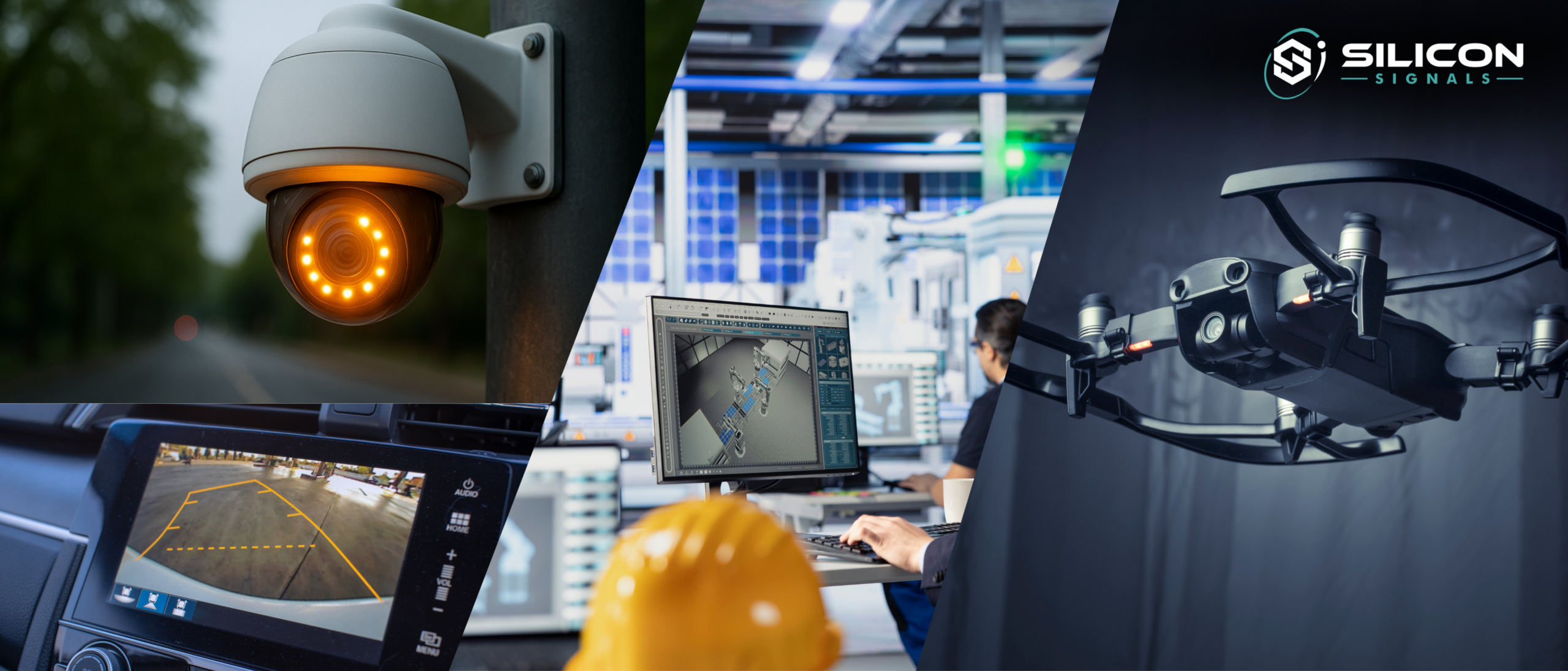
Surveillance Cameras
Surveillance systems work all the time, even when the light is bad. They need to find a good balance between sensitivity, noise, and motion handling. Camera design engineering solutions for surveillance focus on making cameras work well in low light, keeping the exposure stable, handling infrared, and being reliable over time. This is why professionally made cameras work better than off-the-shelf modules at night and in mixed lighting.
Automotive Cameras
Automotive cameras have to work in tough conditions and meet safety standards. Latency, reliability, and consistency are more important than how good the picture looks. Automotive camera design engineering services focus on quick response, stability at different temperatures, integration of functional safety, and behavior that can be predicted in all lighting situations.
Industrial Vision
When it comes to industrial cameras, accuracy is more important than looks. For motion capture, defect detection, and measurement, timing and distortion must be very precise. Here, camera design engineering makes sure that the shutter, optics, and ISP settings work together to give you results that are always the same and can be measured.
Drones and Robotics
Drones need cameras that are light and can work when they are moving or vibrating. For AI and navigation, robotics needs consistent perception.
Here, engineering is mostly about managing motion, making sure everything is in sync, and connecting things to processing pipelines.
Designing a camera-based product for surveillance, automotive, or embedded vision?
Real-World Engineering Perspective
When we start a camera project at Silicon Signals, we don’t usually ask about resolution. They start with use cases.
In surveillance projects with many IPC SKUs, it is very important that the performance is the same across all of them. That means that disciplined camera design engineering services need to be able to tune, validate, and control firmware across different product families.
In embedded vision systems, particularly those incorporating AI, camera performance has a direct effect on the accuracy of algorithms. Small changes in exposure or color can make a model work less well. To fix this, we need system-level camera design engineering solutions, not just one-off fixes.
These experiences strengthen one fundamental truth. You don’t find out how well a camera works; you design it.
Why Camera Design Engineering Improves Performance Over Time
A well-made camera doesn’t just work well the first day. It works the same way in all settings, over time, and in all production batches.
That kind of consistency makes people trust you. Have faith in surveillance systems. Have faith in safety systems. Have faith in industrial automation.
The real value of professional camera design engineering services and well-thought-out camera design engineering solutions is that they give you a long-term performance boost.
Conclusion: Performance Is the Outcome of Engineering Discipline
There is no magic in how a camera works. It’s not a matter of luck. And it’s not just about getting better parts. It is the result of planned engineering choices made at the system level in optics, sensors, ISP tuning, firmware, mechanics, and validation.
When camera design engineering is done correctly, the camera’s performance gets better on its own. The pictures get clearer. Behavior becomes easy to guess. Things you buy become reliable.
This is why companies that put money into good camera design engineering solutions early on always do better than those that see cameras as interchangeable parts. This way of thinking affects how camera systems are built, tuned, and tested at Silicon Signals. Because performance isn’t a feature of real-world products. It’s your job.
