

Introduction
Visual data has become a critical part of how these devices interact with the world. Cameras are no longer just used to take photographs or record videos. Cameras are used in driver assistance systems in vehicles, in robots in manufacturing environments, in medical imaging devices, and as the “eyes” of AI-driven edge devices.
A report by IDC estimates that the global datasphere will be 175 zettabytes in size by 2025, and a large percentage of this will come from cameras and other vision-enabled devices. An industry estimate by Markets and Markets estimates the total embedded vision market will exceed $50 billion by 2030, driven by automotive, robotics, healthcare, and industrial automation applications.
These figures show why many product teams today consider the camera system an integral part of the system rather than an accessory. But designing an embedded camera system is a complex task that demands coordination at various levels, including hardware, optics, firmware, image processing, and software integration.
This is where camera design services help product companies design and integrate camera systems that meet strict performance, reliability, and cost constraints.
This guide will explain camera design services, the construction of embedded camera systems, and the things to consider when integrating camera systems into products.
Understanding Camera Design Services
Camera design services is the term used to define the entire process of developing a camera system that is optimized for use in a particular product or application. This entire process, starting from the selection of the camera sensor to the enhancement of the quality of the camera, is defined as camera design services.
Unlike other cameras, embedded cameras are designed to perform in a particular environment with strict limitations.
A camera system is composed of several layers, and camera design services ensure all of these layers are functioning correctly and working together in the best possible way. The optical portion of the camera is responsible for capturing light, and the image sensor is responsible for converting this light into electrical signals. The image signal processor is then responsible for converting this signal into a useful image, and the firmware and software ensure proper data handling, as well as interpreting and using the image.
The camera design services are useful for product development teams who need to create a product with camera functionality.
Why Embedded Camera Systems Are Technically Complex
A modern embedded camera system is much more than simply an image sensor connected to a processor. Each part has an impact on the quality, performance, power consumption, and stability of the system.
The image sensor has an impact on the resolution, frame rate, dynamic range, and sensitivity. The lens has an impact on the field of view, depth of field, and lens distortion. The processor has an impact on data bandwidth, image processing, and application performance.
In addition to hardware, firmware and software components have an equally important role to play. Camera drivers must interface correctly with an operating system, such as Linux or Android. Multimedia frameworks must handle video streaming and encoding. Image processing software must improve the quality of the image by providing accurate colors and reducing noise.
Yet another set of challenges is introduced by environmental factors. Cameras used for automotive applications have to withstand extreme temperatures. Cameras used for inspection in industrial settings have to provide clear images under changing lighting conditions. Medical cameras have to provide extremely accurate imaging for diagnostics.
This is to say that camera development is rarely accomplished by means of generic solutions. Most cameras have to be designed from scratch, and software stacks have to be fine-tuned, and image quality has to be fine-tuned as well.
Core Elements of Embedded Camera Design
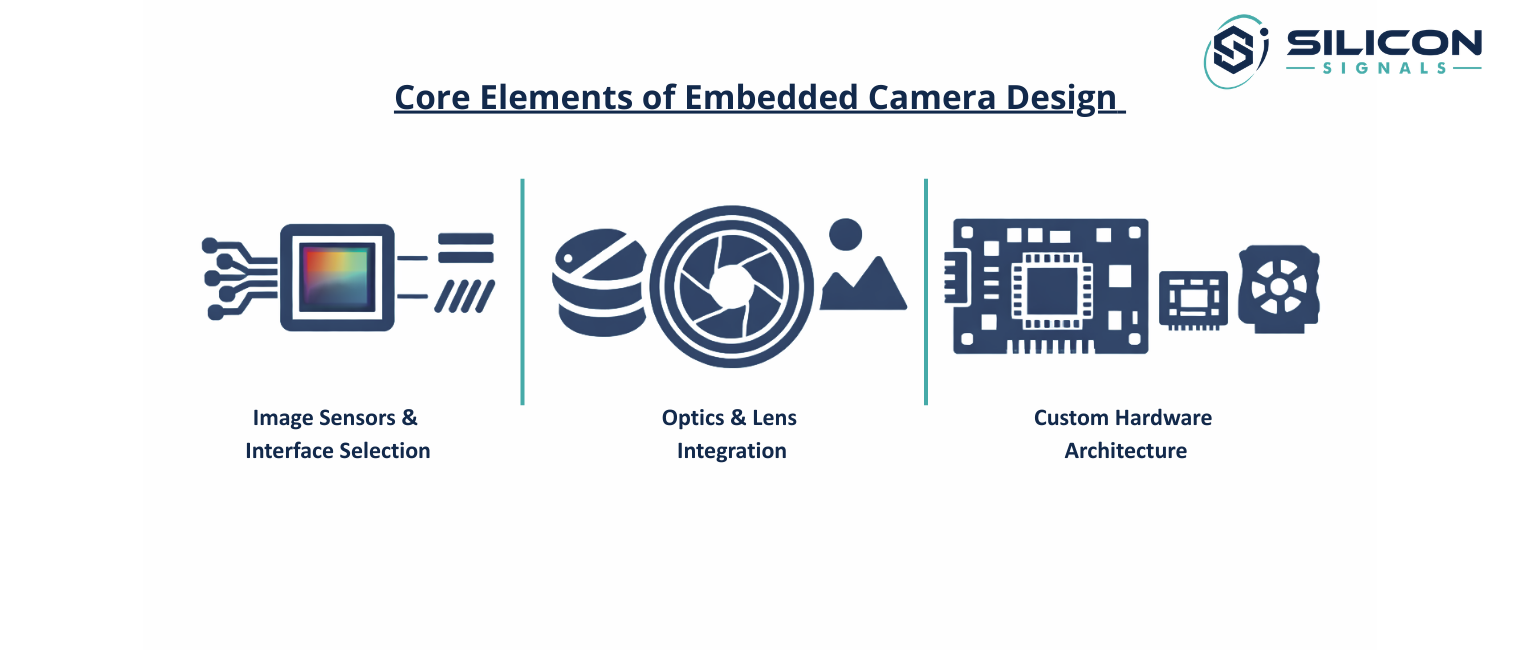
Image Sensors and Interface Selection
Image sensors are the basic building blocks of camera systems. They take the incoming light and convert it into digital information for the camera system.
Most camera systems use CMOS sensors for their low power consumption, high frame rates, and strong integration capabilities. However, the selection of the sensor depends on various parameters like resolution, frame rate, pixel size, dynamic range, and sensitivity.
Interface compatibility is another critical aspect of the camera system. Image sensors use interfaces like MIPI CSI-2, HiSPi, and parallel camera interfaces to communicate with the processor. This is another critical aspect of the camera system.
Selecting the right sensor and interface during the initial stages of the camera system avoids performance issues in the later stages of the product life cycle.
Optics and Lens Integration
The optics define the way in which the light falls onto the sensor, and this is a significant factor in the quality of the image.
The lens parameters, the focal length, aperture, and field of view, affect the way in which the camera views the world. For example, surveillance systems often require wide-angle lenses, whereas inspection systems require narrow fields of view.
Distortion, chromatic aberration, and focus need to be taken into account when selecting the lens. Mechanical alignment between the lens and sensor is also important, especially when high-resolution images are involved.
Several lenses are often considered during the design phase, balancing optical performance, lens size, and cost.
Custom Hardware Architecture
Embedded camera systems may also require custom electronics, which may include cameras, carrier boards, and processor integration.
Hardware design considerations may include signal integrity, power management, thermal considerations, and form factor considerations. For high-speed camera interface standards like MIPI CSI 2, proper PCB design is important for signal integrity.
The product development team may also need to consider the processor or system-on-module for the image processing and application processing. Camera-enabled products may use SoCs provided by NXP, Qualcomm, NVIDIA, etc. A good hardware platform is important for the proper functioning of the cameras.
The Software Stack Behind Camera Systems
Camera Drivers and BSP Development
Hardware, in itself, is unable to generate images. The camera drivers and the board support packages handle the responsibility of facilitating the communication between the sensor, the processor, and the operating system.
The development of the camera drivers includes the implementation of the sensor control, the data pipeline, and the synchronization between the camera components.
The operating systems, including the Linux operating system, rely on the frameworks provided by the Video4Linux2 framework for the camera devices. The Android operating system needs to be integrated with the camera HAL and the multimedia frameworks.
The reliability of the overall camera pipeline is based on the stable development of the camera drivers.
Multimedia Framework Integration
Once the camera is active, multimedia frameworks handle the processing and transmission of the video data.
Multimedia frameworks like GStreamer and FFmpeg provide tools to create a pipeline for streaming, recording, encoding, and processing video in real time. These frameworks also provide access to the hardware acceleration capabilities provided by current processors.
Integration with these frameworks enables multimedia applications like video conferencing devices, industrial inspection systems, and artificial intelligence-based surveillance systems.
Multimedia frameworks provide a way to create efficient multimedia pipelines, reducing latency and improving performance across different operating environments.
Image Signal Processing and Image Quality Tuning
Even if the camera has quality hardware, the raw data obtained will not provide a quality image. Image signal processors are used in the process of converting raw pixel data into a visually correct image.
The ISP process has several steps, which include demosaicing, noise reduction, color correction, sharpening, and tone mapping.
There are several camera tuning processes, which include auto-exposure, auto-white balance, and autofocus. These processes are used in the tuning of cameras, and they must be able to respond to changes in the lighting environment while maintaining visual stability.
Other processes may include HDR, which stands for high dynamic range, and low light optimization, which is for night environment applications.
Image quality tuning is important for the functionality of camera systems in the real world.
Industries Driving Demand for Camera Design Services
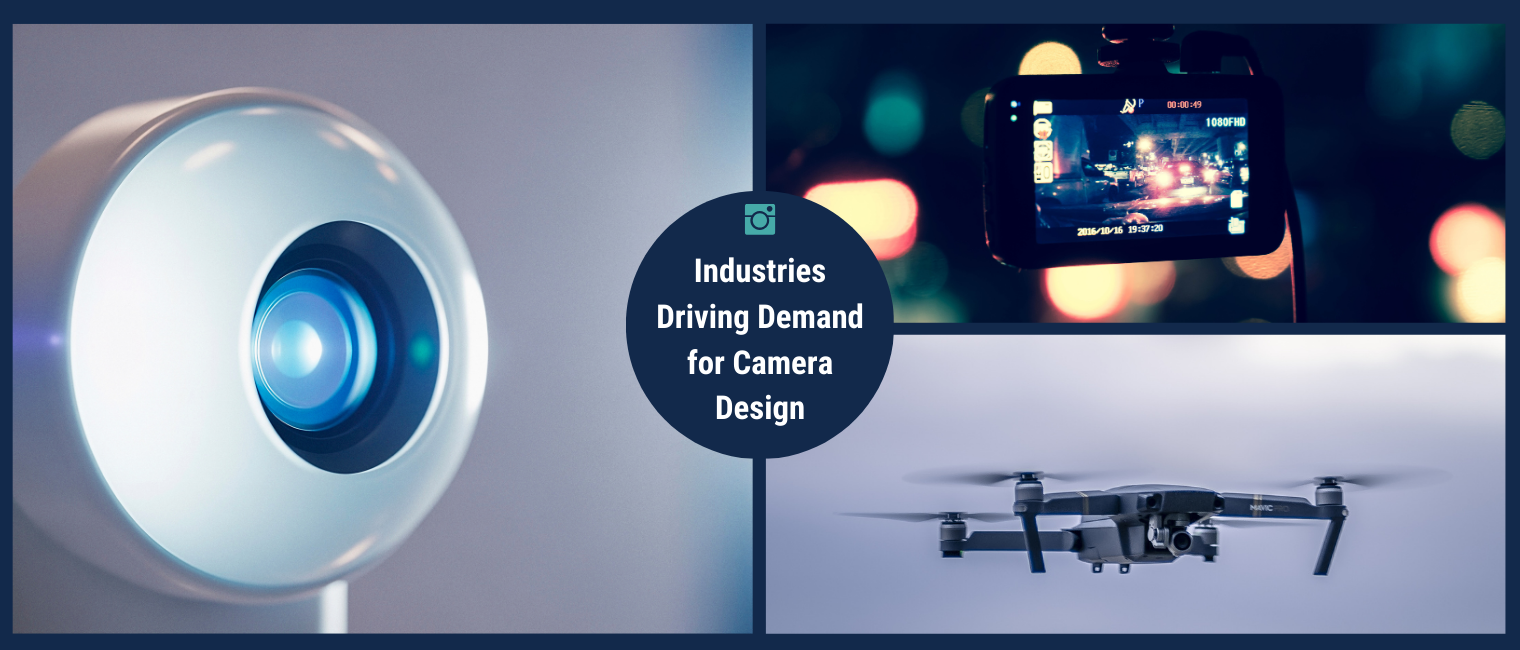
Automotive and Driver Assistance
Automotive systems are also heavily dependent on cameras, especially in safety and automation features. Cameras are used in driver monitoring systems, and surround view cameras are used in automotive systems.
ADAS platforms are heavily dependent on accurate visual data, and cameras are used in these systems. Weather conditions are also a major factor in the testing of these systems.
Healthcare and Medical Imaging
In the field of medical imaging, the level of clarity and precision is extremely high. Cameras are used in endoscopy, surgical, and diagnostic imaging systems.
There are also regulations in the field of medical imaging, and these systems are also required to be validated.
Industrial Automation
Factories are increasingly employing machine vision systems to monitor their production processes, inspect their products, and control their robotic systems.
Industrial cameras have to be used under conditions where lighting, vibrations, and temperature changes occur.
Aerospace and Drone Systems
Unmanned aerial systems employ cameras for navigation, surveillance, mapping, and inspection. The weight, power efficiency, and data bandwidth of cameras have to considered.
Consumer and Smart Devices
Smart home devices, AR/VR systems, and high-end video conferencing systems all employ cameras as integral parts.
The cameras have to be compact, power-efficient, and cost-effective.
