

Introduction
Over 70% of contemporary embedded vision products now rely on software-defined or firmware-controlled image signal processing rather than fully fixed-function hardware pipelines, according to industry analyses from Yole Group. The popularity of software did not cause that change. It occurred as a result of camera systems’ inability to scale, adjust, and distinguish without embedded firmware.
This actually has a straightforward meaning. The sensor and silicon ISP block are no longer the only factors influencing image quality. The firmware that configures, sequences, adapts, and gradually learns how that ISP operates in the real world shapes it.
The question of whether firmware around the ISP is still necessary if you’re building an embedded camera system today, whether it’s for smart IoT devices, medical imaging, industrial vision, or automotive sensing. How deeply that firmware should be involved and what happens if it isn’t are the actual questions.
This is where embedded firmware development for ISP in camera systems becomes essential, acting as the control layer that turns raw imaging hardware into a dependable product.
Let’s dissect it thoroughly, beginning with the origins of image signal processing and the reasons embedded firmware became inevitable.
Origin of Image Signal Processing
The world of early digital cameras was very different. There were fewer use cases, lower resolutions, and simpler sensors. Nearly all image signal processing was done on hardware.
Integrated circuits tailored to a particular application were created to perform a single task. Demosaic the sensor’s raw Bayer data, apply color correction, lower noise, and remove pixels. These ASICs were dependable, quick, and power-efficient. Engineers were able to modify parameters or algorithms without having to redesign silicon thanks to the flexibility provided by digital signal processors.
Because imaging issues were largely known beforehand, this model was successful. The lighting was regulated. Scenes were predictable. Devices performed a single task in a single setting. Then everything was different.
The number of variables skyrocketed as cameras entered automobiles, factories, hospitals, cities, and phones. The lighting became erratic. The number of sensors increased. Frame rates went up. Budgets for latency tightened. Hardware pipelines that were one size fits all ceased to make sense.
At that point, image signal processing started to move toward software-driven control, with embedded firmware serving as the brain that links application intent, ISP hardware, and sensor behavior.
Is your camera ISP failing in real-world conditions?
Hardware Components That Shaped Early ISP
Application-Specific Integrated Circuits
Fixed pipelines were the focus of ASIC-based ISP optimization. Gamma curves, noise filters, color correction matrices, and demosaicing were either hardwired or barely adjustable. Although adaptability was nearly nonexistent, performance per watt was outstanding.
Every significant modification required a fresh silicon revision. For consumer cameras that are updated every few years, that might be acceptable, but in industrial or automotive programs that require long lifetimes and field updates, it quickly breaks down.
Digital Signal Processors
Programmability was introduced by DSPs. In software that runs on specialized processors, engineers could incorporate algorithms for noise reduction, exposure control, and white balance.
However, DSPs continued to reside near the hardware. There wasn’t much memory. Toolchains were intricate. Additionally, even though they increased flexibility, the issue of adjusting ISP behavior in wildly disparate environments remained unresolved.
The missing layer turned out to be embedded firmware, which operated alongside the ISP on general-purpose CPUs.
Fixed Algorithms and Their Boundaries
Deterministic Pipelines
Conventional ISPs used deterministic, fixed algorithms. Bilinear or edge-directed interpolation was used in demosaicing. Static matrices obtained from laboratory calibration were used for color correction. Histogram-based rules were used for auto exposure. Spatial or temporal filters with predetermined thresholds were used for noise reduction.
Predictability was a benefit. The output was consistent given a known input. The timing was predetermined. It was simpler to become certified.
The moment circumstances changed, the drawback became apparent.
Scenes with low light broke noise models. White balance was confused by mixed lighting. Scenes with a high dynamic range either crushed shadows or clipped highlights. Simply put, fixed algorithms lacked sufficient context to adjust.
Where Things Started to Crack
These restrictions became intolerable as camera systems moved into perception-driven and safety-critical domains. You can’t ship a camera on a large scale if it performs well in a lab but struggles with sodium vapor lights, rain, glare, or motion blur.
At this point, embedded firmware started to play a bigger part, dynamically coordinating ISP behavior instead of handling it like a static pipeline.
Advantages and Limits of Traditional ISP
Conventional ISP architectures were very good at some things. They provided low-latency, real-time processing. They are compatible with limited memory and power budgets. They were trustworthy and easily understood.
However, their constraints were not incremental but structural. In edge cases, fixed algorithms had trouble. Updates became costly and slow due to hardware-centric designs. Significant redesigns were needed to incorporate new methods.
This actually means that traditional ISP designs were made to solve issues from the past, not the present.
Bridging the Gap with Computer Vision
ISPs began incorporating concepts from computer vision as processing power increased. Exposure was informed by face detection. Tone mapping was modified by scene classification. Noise reduction was enhanced by motion estimation.
Seldom were these features fully integrated into the ISP hardware. Rather, real-time ISP parameter reconfiguration, decision-making, and frame analysis were handled by embedded firmware operating on application processors.
Although the results were better, this hybrid approach still mainly relied on manually created rules. Although the system was able to identify a face, it was unable to fully comprehend the scene. Motion was detectable, but intent was not.
AI-based image signal processing was made possible by that restriction.
AI-Based Image Signal Processing and the Role of Firmware
Learning From Data
Neural networks trained on large datasets are the foundation of AI-ISP systems. Unlike fixed algorithms, these models are capable of learning patterns. In contrast to rule-based systems, they are able to comprehend texture, context, semantics, and noise characteristics.
This is the problem, though. These models are not standalone. Model execution, memory movement, ISP pipeline synchronization, and fallback behavior under changing circumstances are all controlled by embedded firmware.
AI-ISP wouldn’t be a product without firmware; it would only be a research demonstration.
Adaptability and Personalization
ISP behavior can change depending on the device, scene, and even user thanks to embedded firmware. Depending on the temperature of the sensor, the properties of the lens, the motion state, or the priority of the application, parameters can vary dynamically.
Firmware in industrial systems can adjust ISP behavior for analytics, monitoring, or inspection modes. It can put attention to detail ahead of aesthetics in medical imaging. It can strike a balance between latency and clarity in automotive systems. Without firmware, this degree of control is just impossible.
Performance Under Pressure
Although AI-based methods are computationally costly, they excel under challenging circumstances. Firmware determines how to satisfy real-time constraints, when to use AI models, and when to rely on traditional ISP blocks.
Raw computer is transformed into usable image quality by this orchestration layer.
Embedded Firmware Development for ISP in Camera Systems
The layer that transforms an image signal processor from a static hardware block into a controllable system is called embedded firmware development. The ISP itself lacks awareness of intent, environment, and system-level priorities; it is built to efficiently carry out pixel-level operations. That intelligence is provided by firmware. It sets up processing blocks, initializes the imaging pipeline, and makes sure the ISP behaves consistently throughout lengthy product lifetimes, boot cycles, and operating modes.
The ISP in camera hardware exposes dozens, sometimes hundreds, of registers that specify how raw sensor data is converted into usable images in real-world camera systems. Correctly configuring these registers and, more crucially, modifying them over time are the responsibilities of embedded firmware development. Sensor bring-up, frame timing control, memory buffer management, and system-wide synchronization are all included in this. When real-world conditions diverge from lab assumptions, these configurations become unstable and brittle due to the lack of firmware in the loop.
Firmware is most useful when it comes to tuning and sequencing. Precise ordering of operations is necessary for modern pipelines: color processing must take into account both sensor behavior and application requirements, exposure updates must match frame boundaries, and noise reduction settings must monitor gain changes. In order to ensure that the ISP in the camera reacts coherently rather than as a collection of disjointed blocks, embedded firmware development deterministically controls this sequencing.
In the end, this makes adaptation to the real world possible. Different ISP behavior is required for motion, temperature drift, lighting changes, sensor aging, and use-case switching. Firmware makes it possible for those modifications to occur dynamically without requiring hardware redesigns or field device replacements. This flexibility is what separates a camera system that just works from one that operates consistently in production settings.
Locked into ISP behavior you can’t adapt or update?
Why Embedded Firmware Is Central to Modern ISP Design
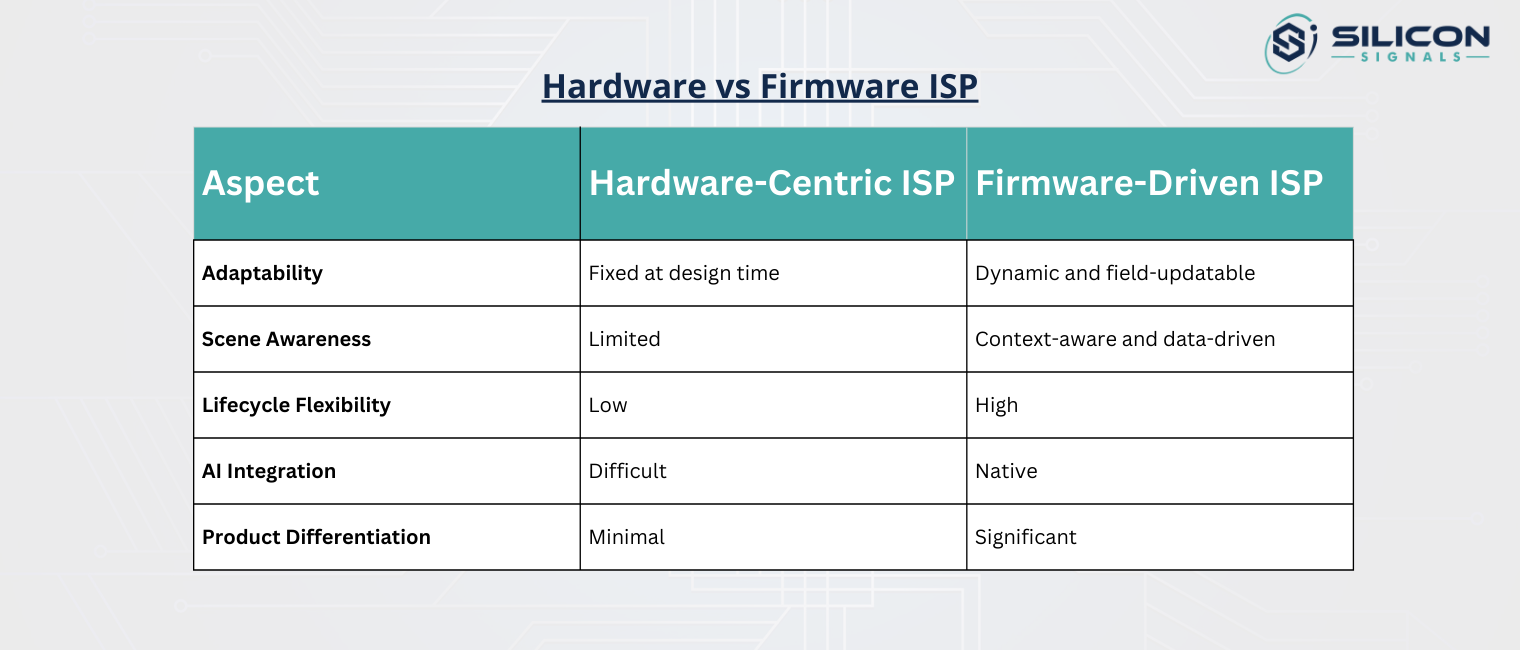
It’s important to be clear now. Firmware that is embedded is not an add-on. It is the imaging system’s control plane.
Sensor initialization, ISP pipeline configuration, memory buffer management, multi-camera setup synchronization, and feedback-based processing adaptation are all done by firmware. It makes long-term maintenance, product differentiation, and over-the-air updates possible.
To make this concrete, consider the following comparison.
Drivers Behind the Shift to Firmware-Centric ISP
Hardware Developments: Along with ISP blocks, modern SoCs also feature potent CPUs, GPUs, and AI accelerators. It is possible to divide tasks intelligently in this heterogeneous compute environment, but only if firmware coordinates them.
Software Innovation: Research on algorithms is still advancing quickly. Learning-based models, HDR methods, and new denoising techniques are frequently introduced. These innovations can be implemented in deployed products without requiring a redesign of the hardware thanks to firmware.
Data Availability: ISP behavior can be continuously improved thanks to large, labeled datasets. The mechanism for safely and reliably deploying updated models and parameters is provided by firmware.
Using embedded firmware for ISP is not a technical preference if you are designing an embedded camera today. It’s a business choice.
By enabling tuning after deployment, firmware-based ISP control lowers risk. By separating image quality and hardware work, it reduces development cycles. In markets where sensors and SoCs are becoming more and more standardized, it allows for differentiation.
Systems that appear flawless in demos but malfunction in production are frequently the result of skipping this layer.
Conclusion
Isolated hardware components or complex algorithms are no longer the only methods used in modern image signal processing. It concerns how embedded firmware, ISP hardware, sensors, and AI models interact to form a cohesive system.
Strong embedded firmware development is what allows the ISP in camera platforms to scale, adapt, and remain viable over long product lifecycles.
Silicon Signals concentrates its camera engineering efforts precisely in this area. Silicon Signals assists product teams in developing camera systems that are flexible, adaptable, and dependable in real-world scenarios by considering embedded firmware as the ISP’s control layer rather than an afterthought.
It’s typically a firmware issue masquerading as an ISP issue if your camera pipeline functions well on paper but struggles in production or if image quality tuning feels constrained by silicon limitations. System-level thinking, not discrete fixes, is needed to solve it.
