

Sensors and smart cameras are no longer “future tech.” They are already everywhere, keeping an eye on factory lines, managing traffic, protecting buildings, and powering smart cities. These devices don’t just collect data; they also look at situations, start actions, and make decisions right away.
But here’s the hard truth: as these systems get smarter, they also become easier to hack. Most IoT security breaches don’t happen in fancy apps or dashboards. They start much earlier, at the level of the device and architecture. That’s why you can’t just add security at the last minute. From the start, it needs to be a part of the system.
It’s not just smart for organizations to invest early in secure design through mature IoT Development Services when they use smart cameras and sensor-based IoT systems; it’s also necessary for trust, compliance, and long-term growth.
Why security is so important for smart cameras and sensors
Smart cameras and sensors are different from regular IT systems because they are in the real world. They are often left alone and always connected, sitting on factory floors, street poles, warehouses, and remote sites. That mix makes them strong and weak at the same time.
When security doesn’t work, bad things can happen:
- Getting into live video or sensor data without permission
- People are stealing devices and using them in botnets.
- Data that has been changed can cause false alarms or bad choices.
- Loss of trust from customers and fines from the government
The device is where security begins
The device itself is the first step in making an IoT system safe. Nothing else can fully make up for weak hardware or firmware.
Smart cameras and sensors that are well-designed usually have:
- Every device has its own identity (no passwords that are shared)
- Secure boot to stop unauthorized firmware
- Key storage that is backed by hardware when possible
- Limited access to debug and physical access
If you don’t do these things, even the safest cloud platform won’t be able to fix the system later.
You must have secure communication
Smart cameras and sensors are always talking to gateways, edge systems, cloud platforms, and apps. Attackers could get in through any of the connections.
A safe IoT architecture makes sure that:
- Encrypted communication all the way up the stack
- Both sides check each other to make sure they are who they say they are.
- Protection against replay and man-in-the-middle attacks
- Handling dropped or intermittent connections safely
Strong IoT Development Services build these protections right into the data flow instead of adding them later.
Limits of Off-the-Shelf Camera Modules
There are good reasons to have standard camera modules. They are easy to add to other systems, cheap when used in small amounts, and work well on many platforms. They are often the quickest way to go for prototypes and early validation. The problems show up when the product goes beyond proof of concept.
Most standard modules are made to work in a wide range of situations. Normal lighting. Moderate heat levels. Standard mechanical layouts. When your application doesn’t follow those rules, compromises start.
Extra shielding is put on to control noise. Mechanical adapters are used to fix problems with alignment. Firmware workarounds make up for how images act. To keep things stable, power margins are raised.
These changes seem easy to handle on their own. Together, they weaken the integrity of the system. The performance of images varies from one environment to another. Mechanical tolerances get tighter and more fragile. Power use goes up more than what was first thought. And when a module is changed or stopped, the risk of supply forces a redesign.
What began as a simple integration option turns into a recurring engineering issue. The camera doesn’t solve the problem; instead, it becomes a long-term limit on performance and scalability.
Perfect Fit and Optimal Mechanical Integration
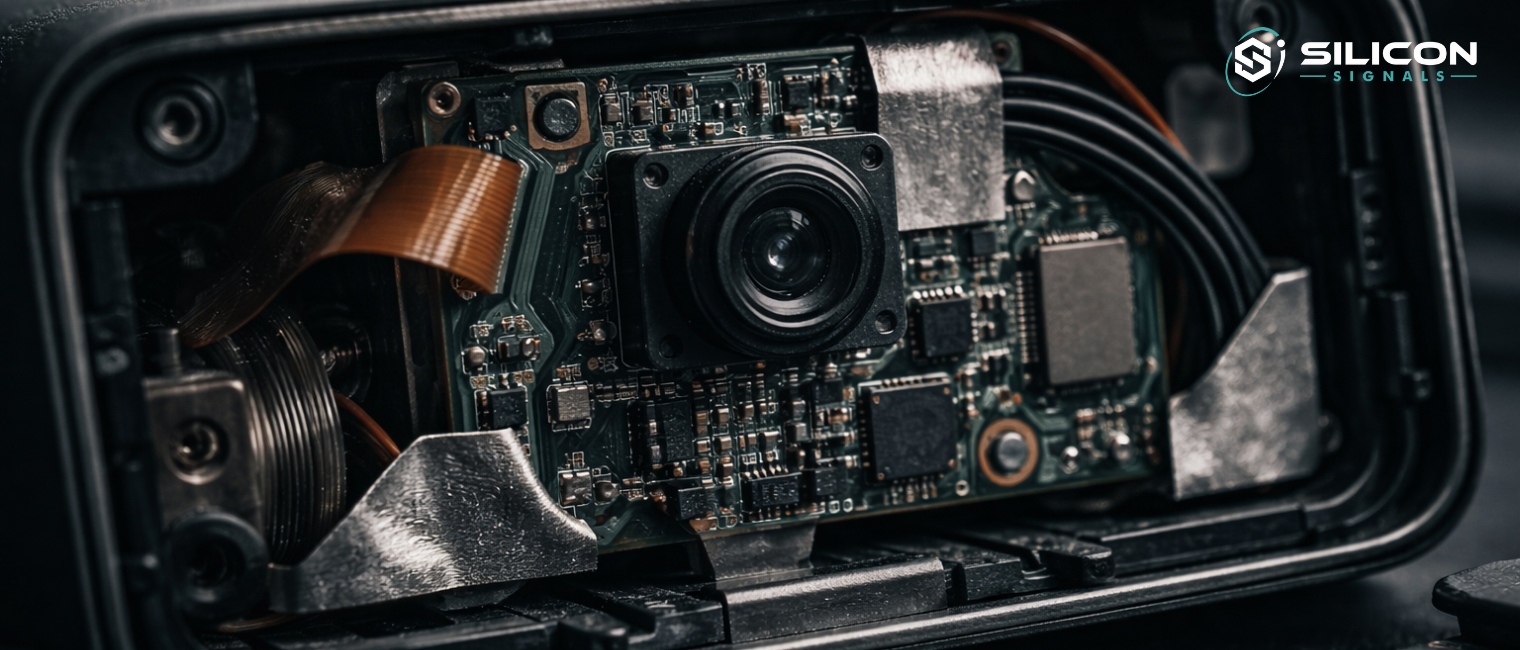
Mechanical alignment is one of the most underappreciated advantages of custom embedded camera design. Standard camera modules have predetermined connector locations, lens heights, and fixed sizes. You modify the enclosure if they don’t fit your enclosure. This frequently entails less-than-ideal optical alignment, thicker housings, or awkward mounting brackets.
That relationship is reversed by custom camera systems. The internal geometry of the product is taken into consideration when designing the PCB outline, connector orientation, mounting holes, and even lens position.
In actuality, this means fewer concessions. The existing space is accommodated by the camera. Cable routing gets more tidy. Because traces and grounds are planned rather than extended, EMI behavior improves. It becomes easier and more consistent to assemble.
This degree of fit is not cosmetic for small products such as wearables, industrial sensors, medical devices, or automotive modules. Yield, dependability, and long-term serviceability are all directly impacted.
Performance Tuned to the Exact Use Case
Standard camera modules are designed to reasonably satisfy a wide range of applications. Systems for embedded cameras are designed specifically to meet the needs of a single application. That distinction is important.
Certain products need to function in extremely low light levels while maintaining texture and minimizing noise. For others, rolling shutter distortion is unacceptable when capturing fast-moving objects. Some people need exact color accuracy. Some are more interested in spectral filtering or near-infrared sensitivity.
The sensor is picked especially for those limitations with a custom design. The lens is matched to the desired depth of field and pixel size of the sensor. Instead of using a generic test chart, the ISP pipeline is adjusted for the real scene statistics that the product will encounter.
The real gains come from this tuning. reduction of noise without losing detail. exposure behavior that doesn’t change with temperature. white balance that remains steady in a variety of lighting conditions.
Raw sensor specifications rarely limit performance in embedded camera systems. It is constrained by the system’s tuning. You have control over that tuning with custom design.
Image Processing and ISP Control
Image processing is done under strict guidelines in many products. restricted computing power. strict budgets for latency. envelopes of fixed power.
Standard modules frequently expose only a limited set of controls or lock down ISP behavior. Until you need to make a fundamental change, such as how HDR is handled or how motion artifacts are suppressed, that is acceptable.
Deeper ISP integration is made possible by custom embedded camera designs. What operates on the SoC, what operates on the sensor ISP, and how data moves between them are all up to you. Instead of focusing on peak quality, pipelines can be tuned for deterministic latency. Instead of focusing on benchmark scores, you can optimize for thermal stability.
This is the problem. Consistency is more important than theoretical maximum quality when vision feeds downstream AI or control logic. You can optimize for that consistency with custom camera systems.
Product Differentiation Through Vision
In competitive markets, simply including a camera does not create an advantage. What differentiates a product is what that camera can do that others cannot.
That advantage might come from reliable low-light performance without visible noise. It might be distortion-free capture of fast-moving subjects. It could be a compact form factor competitors cannot replicate. Or it may be stable imaging performance sustained over a decade-long lifecycle. When the camera is engineered specifically for the product, vision stops being a checkbox feature. It becomes a defining capability.
Custom embedded camera systems embed performance into the architecture itself. Because the camera is purpose-built, it cannot be easily swapped or replicated. Imaging behavior becomes part of the product’s identity, not a replaceable component.
For OEMs in industrial, medical, and automotive markets, that differentiation often justifies the initial investment. It transforms vision from a commodity into a competitive edge.
Cost Efficiency at Scale
Cost is one of the most common misconceptions regarding custom camera design. Yes, there are one-time, non-recurring engineering expenses. Cost, however, is more than just the price per unit in the initial batch. It is the total cost of the product over its whole lifecycle.
Features and packaging that you might not want are included in standard modules. In each unit, you bear the cost of that waste. It is eliminated by custom designs. The components are carefully chosen. There are fewer assembly steps. Testing is in line with the real needs.
Those savings compound as volumes rise. Amortization is applied to the NRE. Costs per unit decrease. Pricing for supplies becomes more predictable.
Often, the outcome defies logic. A custom embedded camera system can be less expensive overall at moderate to high volumes than a standard module that initially appeared to be less expensive.
Long-Term Supply Stability
Compared to consumer devices, embedded products have a longer lifespan. It is typical to have five, seven, or ten years. That horizon is rarely taken into consideration when designing standard camera modules.
The cost of redesigning a standard module can be high when it is discontinued. mechanical modifications. revalidation of software. updates on compliance. notifications for customers.
That risk is decreased by a custom embedded camera design. Lifecycles of components are planned. Alternative components are found early. Longer availability is promised by suppliers. Changes are handled within the same design framework when they cannot be avoided.
In actuality, this means fewer surprises in the middle of the lifecycle. This stability is essential for OEMs shipping mission-critical or regulated products.
Struggling to turn product ideas into market-ready solutions faster?
Technical Collaboration and Support
Instead of making a transactional purchase, selecting a custom embedded camera system entails forming a technical partnership.
Teams with experience in camera engineering contribute knowledge that is hard to duplicate internally. Optical compromises. behavior of sensors under temperature stress. ISP tuning techniques. EMC factors. optimizing manufacturing yield.
Instead of lengthening development time, that collaboration frequently reduces it. Issues are foreseen rather than discovered after the fact. System-level implications are taken into consideration when making decisions.
This support can mean the difference between a camera that works in the lab and one that works in the field for teams lacking deep imaging expertise.
When Custom Embedded Camera Design Makes the Most Sense
Not every project is a good fit for custom camera systems. Under specific circumstances, they shine.
Tight Mechanical Restrictions: Customization prevents painful compromises later when mounting geometry, weight, or size are strictly limited.
Specific Imaging Requirements: Standard modules are pushed beyond their comfort zone by low light, high speed, wide temperature ranges, or unusual spectra.
Vision as a Differentiator: Generic solutions are rarely adequate if imaging performance is a key component of the product’s competitive strategy.
Medium to High Production Volumes: The cost benefits of customization become more obvious and convincing as volumes increase.
Long Product Lifecycles: Planned supply and controlled evolution are beneficial for products that need to be supported for many years.
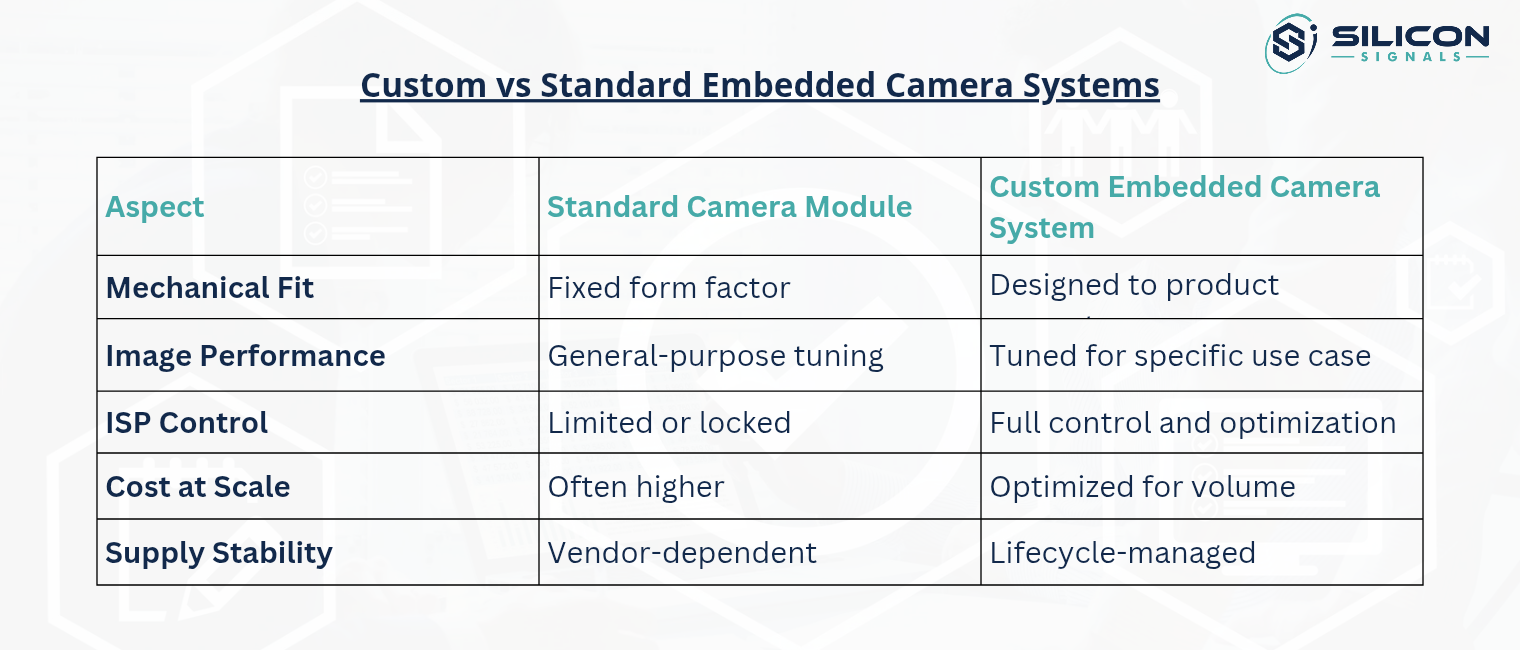
Custom vs Standard Embedded Camera Systems
Conclusion
The goal of designing a custom embedded camera is not to pursue innovation. Eliminating uncertainty is the goal.
Relying on generic modules introduces compromises that later manifest as cost, risk, or differentiation gaps when vision is crucial to product performance. Those problems are addressed at the architectural level by custom camera systems. They match manufacturing, firmware, electronics, and optics to the real needs of the product.
This method frequently signifies the shift for OEMs producing serious embedded products from component adaptation to system engineering. This is precisely how Silicon Signals approaches custom embedded camera systems. As closely linked components of a more comprehensive product architecture rather than as separate modules. Engineering clarity, long-term dependability, and imaging performance that endures outside of the lab are the main priorities.
Custom design typically ceases to be optional and becomes strategic when your product depends on vision and the standard shortcuts are beginning to show their limitations.
